A founder with $2,000 a month to spend on marketing does not have the luxury of “trying everything.” Every dollar has to go somewhere, and the two channels competing hardest for that budget are search engine optimization and pay-per-click advertising. Ask five marketing consultants which one deserves the money, and you will likely get five different answers, because the honest answer depends on the business asking the question.
This article is not another explainer that tells you SEO is free and PPC is fast. It is a working framework for deciding where your next marketing dollar actually belongs, based on your business model, your timeline for revenue, and how much risk you can absorb while you figure out what works.
Direct Answer
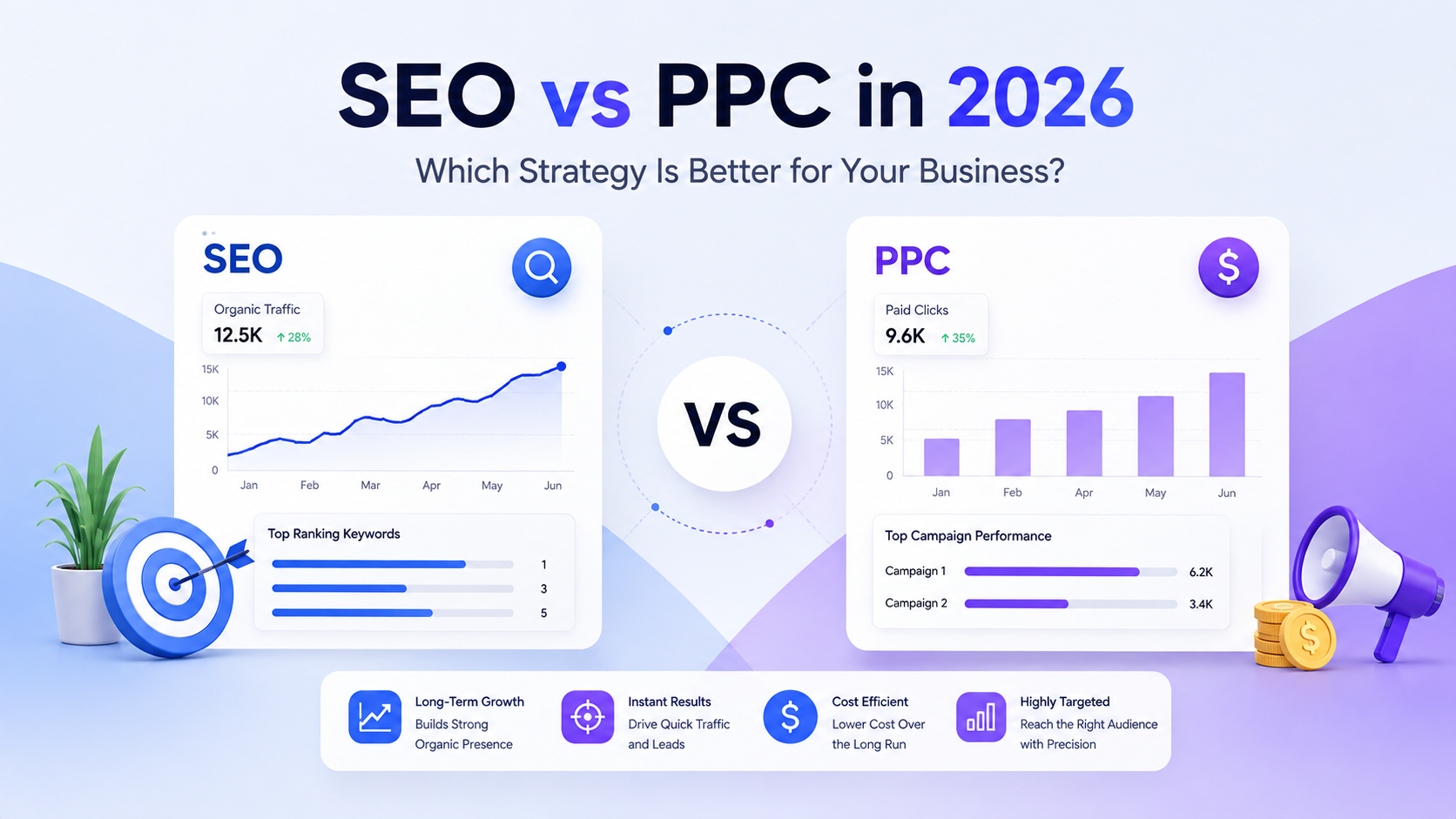
Neither SEO nor PPC is universally better. PPC is the stronger choice when a business needs measurable leads within days and has a budget to test with. SEO is the stronger choice when a business can invest for several months and wants an acquisition channel that keeps producing after the spending stops. For most competitive markets, running both in a coordinated way outperforms either channel alone, because PPC data sharpens SEO targeting and SEO authority lowers the cost of paid acquisition over time.
Key Takeaways
- PPC delivers visibility within hours; SEO typically needs several months before it produces meaningful traffic.
- SEO is not free traffic. It requires sustained investment in content, technical optimization, and authority building.
- PPC is not guaranteed traffic. It requires ongoing spend, testing, and campaign management to stay profitable.
- The SEO vs PPC decision changes based on business model, website age, competition, and how urgently you need customers.
- AI-generated answers in Google Search are reshaping how organic and paid visibility work together, not replacing either one.
SEO vs PPC: What’s the Difference?
SEO is the discipline of improving a website so it earns visibility in the unpaid, organic section of search results. PPC is an advertising model where a business pays each time someone clicks a paid ad, most commonly through Google Ads or Microsoft Advertising.
Both sit inside the same search engine results page, but they operate on different economics. SEO visibility is earned through content quality, technical health, and authority signals, and it can persist without ongoing per-click payment. PPC visibility is rented: it appears the moment a campaign launches and disappears the moment the budget runs out.
SEO vs PPC at a Glance
| Factor | SEO | PPC |
|---|---|---|
| Cost structure | Investment in content, technical work, and expertise; no per-click fee | Ongoing cost per click, plus campaign management |
| Speed | Weeks to months before meaningful traffic | Hours to days |
| Long-term value | Compounds can keep producing traffic after investment slows. | Stops when spend stops |
| Traffic quality | Strong for research and comparison intent; builds trust over time | Strong for high-intent, transactional queries |
| Control | Indirect; you influence, not command, rankings. | Direct control over budget, targeting, and messaging |
| Scalability | Scales with authority and content depth, which takes time | Scales instantly with budget, until CPCs make it inefficient. |
| Testing | Slower to test messaging; SEO experiments take time to measure | Fast, granular A/B testing of ads and landing pages |
| Brand visibility | Builds credibility through consistent organic presence | Builds immediate visibility, but users know it is paid. |
| Best use case | Sustainable customer acquisition and long-term brand equity | Fast, measurable demand generation and product launches |
| Main limitation | Slow to start, vulnerable to algorithm shifts | Expensive in competitive niches, no residual value |
SEO: Where It Works Best
Treating SEO as “free traffic” is one of the most expensive misconceptions in marketing. Ranking organically requires investment in keyword and competitive research, content that genuinely satisfies search intent, technical fixes like site speed and crawlability, internal linking that helps both users and search engines understand your site, and ongoing maintenance as algorithms and SERP layouts change.
What that investment buys is different from what PPC buys. A well-optimized page that ranks for a valuable term keeps generating visits without an additional dollar spent per click. Over 12 to 36 months, that compounding effect is what makes SEO attractive for businesses with the patience to build it. It is also why SEO tends to perform especially well in categories where trust matters, such as professional services, healthcare, and B2B software, where buyers research extensively before converting.
SEO struggles when a business needs revenue this month, when the website is brand new with no authority, or when the competitive set already dominates page one with years of accumulated content and backlinks.
PPC: Where It Works Best
PPC is not simply “paying for traffic.” Running a profitable campaign means managing budget allocation across campaigns, building audience and keyword targeting that matches real search intent, writing and testing ad copy, building landing pages designed specifically for conversion, tracking conversions accurately enough to know what is actually working, and adjusting bids as auction competition and cost-per-click shift.
That operational layer is what separates PPC that generates leads from PPC that burns cash. The advantage is control: you decide who sees your ad, when, and at what budget, and you can test messaging in days rather than months. That makes PPC valuable when a business needs measurable acquisition quickly, such as during a product launch, a seasonal promotion, or when validating whether a new offer resonates before investing months into organic content around it.
PPC becomes a weaker bet in high-CPC industries like legal services or insurance, where auction competition can push cost per click into triple digits, or for businesses without the margin to sustain paid acquisition costs indefinitely.
SEO vs PPC: Cost Comparison
The real comparison is not the headline spend but cost per lead over time. PPC cost per lead tends to stay flat or rise as competitors bid up the same keywords. SEO cost per lead tends to fall over time, because once a page ranks, additional traffic does not carry a proportional cost. The trade-off is upfront risk: SEO spending happens before you know whether it will produce rankings, while PPC spending produces immediate, measurable data on what works, even if some of it is wasted testing.
SEO vs PPC: Speed and Time to Results
PPC campaigns can generate clicks the same day they launch, which makes them the default choice when a business needs to fill a pipeline immediately. SEO generally needs several months before rankings for competitive terms become meaningful, and longer in saturated industries. This is the single biggest reason startups and new websites lean on PPC first: there simply isn’t enough time for organic authority to build before the business needs revenue.
SEO vs PPC: ROI and Long-Term Value
PPC ROI is directly tied to spend. Turn the budget up, get more traffic, up to the point where rising CPCs erode margin. SEO ROI is asset-like: the content and rankings you build continue producing value with less ongoing cost, which is why many analyses of long-term acquisition cost favor SEO once a site has matured, particularly in industries with long sales cycles and high customer lifetime value, as Search Engine Land’s analysis of the SEO vs PPC debate illustrates through real client scenarios where the same channel produced opposite outcomes depending on the business context.
SEO vs PPC: Traffic and Search Intent
Not all search intent behaves the same way across both channels. Users clicking organic results are often earlier in their research, comparing options and building trust in a brand before committing. Users clicking paid ads for transactional queries are frequently closer to a buying decision, which is why PPC often converts well on bottom-of-funnel keywords even at a lower overall click volume. Matching the channel to the stage of intent, not just the keyword, is what separates efficient SEO vs PPC allocation from wasted spend.
SEO vs PPC for Different Types of Businesses
- A local service business often gets outsized value from local SEO and Google Business Profile optimization, with PPC reserved for competitive periods or urgent lead gaps.
- An e-commerce business typically needs both SEO for category and product pages that capture ongoing research traffic and PPC for shopping campaigns and remarketing around peak demand.
- A SaaS business with a long sales cycle tends to benefit more from SEO content that builds trust across a multi-touch buyer journey, with PPC supporting demo requests and branded defense.
- A content or media website is almost entirely dependent on organic and AI search visibility, since its business model is built on search traffic itself.
- A business that needs leads immediately, such as a new location opening next month, has little choice but to lean on PPC while SEO groundwork is laid in parallel.
SEO vs PPC in the Age of AI Search
Google’s AI Overviews and conversational tools like ChatGPT, Gemini, and Perplexity have changed how people research before clicking anything. AI-generated answers can satisfy simple queries without a click at all, which has pressured organic click-through rates on certain informational searches. This does not mean traditional SEO has become obsolete. AI systems still draw their answers from the same web content, entities, and authority signals that organic search has always relied on, so being visible and well-structured in traditional search remains a prerequisite for being cited in AI answers.
What it does mean is that visibility now needs to span more surfaces than before: traditional organic results, paid search, AI-generated answers, and branded search volume that AI tools often use as a trust signal. A business relying on a single channel is more exposed to disruption than one building presence across multiple touchpoints in the customer journey.
Should You Choose SEO, PPC, or Both?
For most businesses beyond the very earliest stage, the honest answer is both, allocated according to timeline. Early on, PPC generates the immediate data and leads a new business needs to survive. As SEO content and authority build, its share of total traffic and its share of budget can grow, gradually reducing dependence on paid spend for the same volume of leads. This is not a rule that applies evenly to every business, but it reflects how the underlying economics of the two channels typically shift over time.
If You Had $1,000 to Spend on Marketing
- A brand-new website with no traffic history: put most of it into PPC to generate immediate data and validate demand, while starting foundational technical SEO work at low cost.
- An established website with existing rankings: put more into content and technical SEO refinements, since the compounding effect is already working in your favor.
- A local business: prioritize Google Business Profile optimization and local SEO, keeping a small PPC reserve for high-demand periods.
- An ecommerce business: split between Shopping/PPC campaigns for immediate sales and product page SEO for ongoing organic capture.
- A SaaS business: lean toward SEO content addressing buyer research questions, with a modest PPC budget for branded terms and demo capture.
- A service business needing leads immediately: PPC first, with SEO started in parallel so dependency on paid spend decreases over subsequent months.
- A content website: SEO is close to the entire strategy, since the business model is built on organic and AI search visibility.
- A business that needs leads immediately regardless of type: PPC is the realistic choice, with the understanding that this is a short-term fix, not a long-term acquisition strategy.
There is no guaranteed outcome for any of these allocations. Results depend on execution quality, competition, and market conditions that no article can promise around.
How to Decide Which Strategy Fits Your Business
Ask three questions before allocating a budget. How soon do you need revenue? If the answer is weeks, PPC has to be part of the mix. How much competition exists for your core keywords? Heavy competition raises both PPC costs and the time SEO needs to show results. How long do your customers take to decide? Longer research cycles favor SEO’s trust-building strengths; impulse or urgent purchases favor PPC’s immediacy.
Common SEO and PPC Mistakes
Businesses frequently expect SEO to produce results within weeks and abandon it before the investment has had time to compound. On the paid side, businesses often launch PPC campaigns without dedicated landing pages, which quietly destroys conversion rates regardless of how well the ads are targeted. Another recurring mistake is treating the two channels as competitors for the same budget rather than sources of data for each other. PPC keyword and conversion data can sharpen SEO content priorities, and SEO-driven brand trust can improve PPC click-through and quality scores.
Final Verdict
Choose SEO when your business can absorb a multi-month runway and wants an acquisition channel that becomes cheaper over time. Choose PPC when you need measurable leads now, are testing a new offer, or operate in a niche where paid budget can be scaled predictably. Choose both when your market is competitive enough that neither channel alone can carry the full weight of customer acquisition, which describes most established industries by 2026. The right mix is never fixed; it should shift as your website matures, your budget grows, and your competitive landscape changes.
Conclusion
The SEO vs PPC decision is really a question about time horizon and risk tolerance, not which channel is objectively superior. A business with patience and a long customer lifetime value has strong reasons to weigh toward SEO. A business that needs revenue this quarter has equally strong reasons to weight toward PPC. Most businesses that scale sustainably end up running both, using each channel’s data to make the other more efficient, rather than treating the choice as permanent.
For related reading on building a broader marketing plan, see 15 Digital Marketing Trends That Will Dominate 2026, and for the technical foundation SEO depends on, see WordPress SEO in 2026: How to Optimize Your Website for Google and AI Search. If your content is ranking but not converting, Search Intent vs User Intent: Why Most Content Fails to Rank in 2026 explains a common reason why.