Most businesses do not fail at digital marketing because they lack tools, budget, or effort. They fail because they skip straight to tactics: run some ads, post on Instagram, publish a blog, send a newsletter, and hope something sticks. Without a strategy connecting those pieces, each channel operates in isolation, and none of them compound.
A real digital marketing strategy is not a list of channels you plan to use. It is a decision-making structure that determines which channels matter, what you say on them, how you turn attention into revenue, and how you know if any of it is working. This guide breaks that structure down into eight connected steps, explains why each one matters, and shows how to apply it whether you run a local business, a blog, an e-commerce store, or a SaaS company.
Direct Answer
A digital marketing strategy is a structured plan that connects a business goal to the audience, offer, channels, content, and measurement needed to reach it. It is built by defining what success looks like first, then working backward through audience, message, and channel choices, rather than picking tactics and hoping they add up to results.
Key Takeaways
- A digital marketing strategy starts with a business goal, not a channel choice. Picking channels before defining the goal is the most common reason strategies fail.
- Trying to use every channel at once spreads budget and attention too thin. Fewer channels, executed well, consistently outperform broad, shallow coverage.
- Content and channel choices should follow directly from who the audience is and what the offer solves, not from what competitors happen to be doing.
- Conversion paths need to be designed deliberately. Traffic without a clear next step is wasted traffic.
- KPIs should measure business outcomes, not vanity metrics like impressions or follower counts.
- AI search and answer engines have added a new visibility layer alongside traditional rankings, and strategies that ignore it are optimizing for a shrinking part of how people find information.
- A strategy is only useful if it gets tested and revised. Treating the first version as final is a common and costly mistake.
What Is a Digital Marketing Strategy?
A digital marketing strategy is the overarching plan that defines what a business is trying to achieve online, who it is trying to reach, and how each marketing activity contributes to that outcome. It sits above individual campaigns and channel decisions, giving them direction instead of letting them operate independently.
People often use “strategy,” “plan,” and “campaign” interchangeably, but they describe different layers of the same work, and confusing them is part of why marketing efforts feel disconnected.
| Term | What It Actually Is | Time Horizon | Example |
|---|---|---|---|
| Digital marketing strategy | The overall direction: goals, audience, positioning, and channel priorities | Long term, usually 12 months or more | Grow qualified leads for a B2B service business by building organic search authority and a direct email list. |
| Digital marketing plan | The tactical roadmap that puts the strategy into action, including timelines, budgets, and responsibilities | Medium term, often quarterly | A content calendar, ad budget allocation, and email cadence for Q1 |
| Digital marketing campaign | A specific, time-bound initiative aimed at one outcome within the plan | Short term, days to a few months | A product launch campaign combining paid social, email, and a landing page |
The strategy answers “why” and “what.” The plan answers “how” and “when.” A campaign is a single execution inside that plan. Skipping the strategy and jumping straight to campaigns is why so many marketing efforts feel like a string of disconnected activities instead of a coherent growth engine.
Why Businesses Need a Digital Marketing Strategy in 2026
Digital marketing in 2026 involves more moving parts than it did even two years ago. Search results now blend traditional rankings with AI-generated summaries. Social platforms double as search engines. Attention is split across more formats and platforms than any single business can realistically cover well.
That fragmentation is exactly why a strategy matters more now, not less. Without one, businesses default to reactive marketing: chasing whatever platform or tactic is trending, publishing content without a clear audience in mind, and running ads without a defined path from click to customer. This scattered approach burns budget without building anything that compounds.
A working strategy also has to account for how discovery itself has changed. Google AI Overviews and tools like ChatGPT and Perplexity now answer many questions directly, which means visibility increasingly depends on being cited as a trustworthy source, not just ranking in a list of blue links. A digital marketing strategy 2026 businesses can actually rely on needs to treat AI search as part of the discovery landscape from the start, rather than bolting it on later.
The 8-Step Digital Marketing Strategy Framework
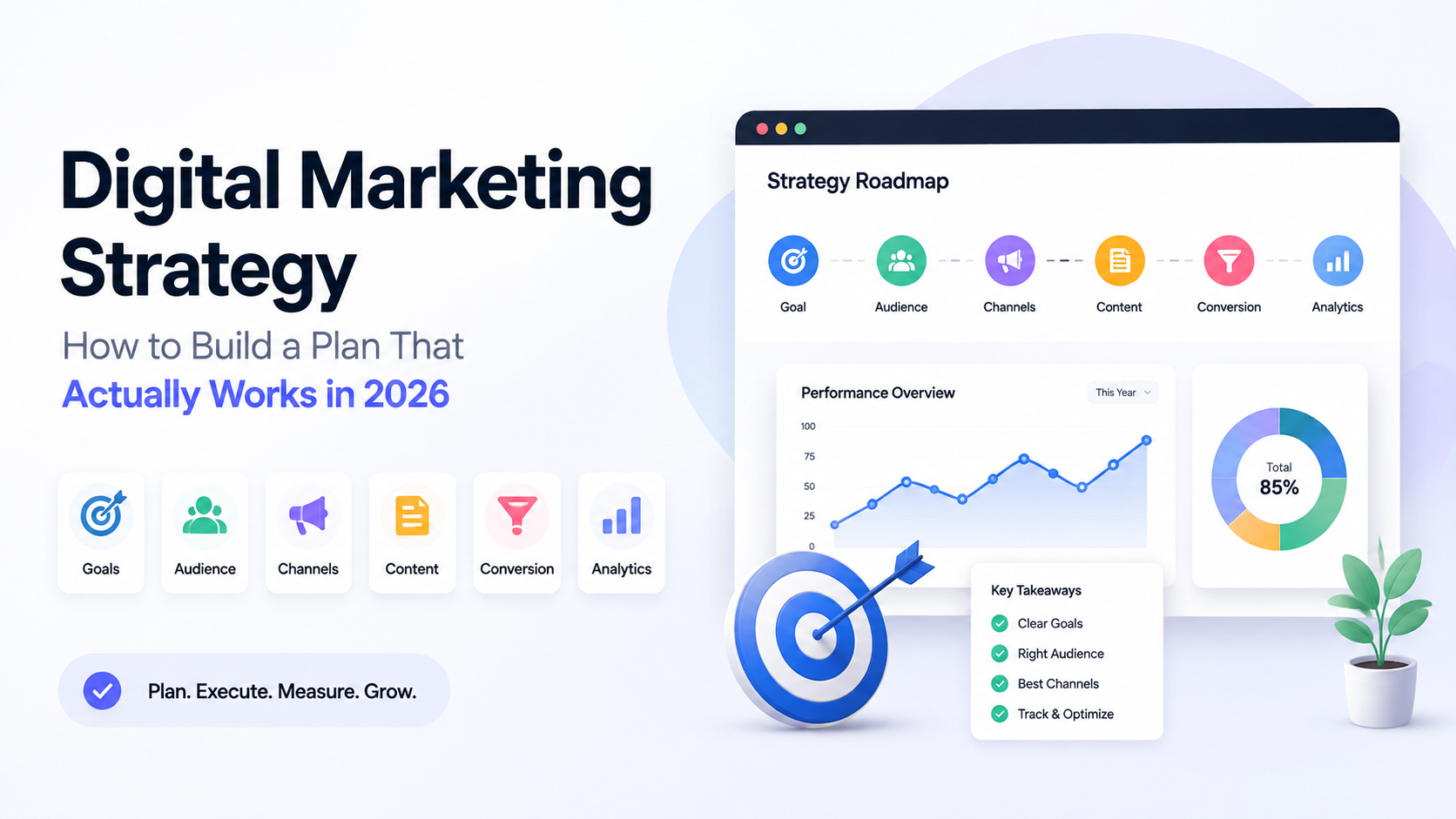
Building a digital marketing strategy that works means moving through eight connected steps in order. Skipping ahead, for example, choosing channels before defining the audience, is where most strategies break down.
- Goal: what the business needs to achieve
- Audience: who has to take action for that goal to happen
- Offer: what you are asking that audience to buy, sign up for, or engage with
- Channel: where that audience can realistically be reached
- Content: what you say to move them from awareness to interest
- Conversion: how attention turns into a lead, sale, or signup
- Measurement: how you know if it worked
- Optimization: what changes based on what you learned
Each stage depends on the one before it. A channel choice made without a clear audience wastes budget. Content made without a conversion path wastes attention. Measurement without a defined goal produces data nobody acts on.
Step 1: Define the Business Goal
Every digital marketing strategy needs to start with a specific, measurable business outcome, not a vague ambition like “grow our online presence.” Common digital marketing goals include generating a set number of qualified leads per month, growing e-commerce revenue by a specific percentage, reducing customer acquisition cost, or building an email list of a defined size within a set period.
The goal determines everything downstream. A SaaS business aiming for demo signups needs a different channel mix and content approach than an e-commerce store aiming for repeat purchases. Write the goal down in specific, measurable terms before choosing a single channel or tactic.
Step 2: Identify the Target Audience
The audience is not a demographic description like “women aged 25 to 40.” It is a clear picture of who needs to act for the goal to be met, what problem they are trying to solve, where they currently look for solutions, and what would make them trust one business over another.
For a small business, this might mean identifying local customers who search for a specific service and compare a handful of nearby providers before choosing. For a SaaS company, it might mean identifying a specific job title inside a specific company size that experiences a specific operational pain point. The more specific this step is, the easier every later decision becomes, because vague audiences lead to vague content and scattered channel choices.
Step 3: Define the Offer and Value Proposition
The offer is what you are actually asking someone to do: buy a product, book a call, start a free trial, or subscribe to a newsletter. The value proposition is the reason that a specific audience should choose your offer over an alternative, including doing nothing.
A weak value proposition tries to appeal to everyone and ends up compelling no one. A strong one is specific about the problem solved and the outcome delivered, and it should be genuinely different from what competitors already claim, not a restatement of generic benefits like “quality” or “great service” that every competitor also claims.
Step 4: Choose the Right Marketing Channels
This is where most businesses go wrong. The instinct is to be present everywhere: a blog, social profiles on four platforms, email, paid ads, and video, all launched at once. In practice, this spreads a limited budget and limited attention so thin that nothing gets done well enough to produce results.
Channel choice should follow directly from where the target audience already looks for solutions and what stage of awareness they are in. A local service business with a defined service area often gets more from local SEO and Google Business Profile optimization than from national paid search. A B2B SaaS company selling to a niche technical audience often gets more from content marketing and LinkedIn than from broad social media presence. Choosing two or three channels that fit the audience and executing them consistently produces better results than covering every available channel poorly.
Step 5: Build a Content Strategy
Content is the material that moves an audience through awareness, consideration, and decision. It only works when it is built around what the audience actually searches for and needs to know, not around what a business wants to say about itself.
This means researching what people are actually asking at each stage of their decision process and creating content that answers those questions directly. A person searching to understand a problem needs an educational article. A person comparing solutions needs a comparison page. A person ready to buy needs a clear product or service page. Publishing the wrong content type for where someone is in their decision process is a common reason content gets traffic but no conversions.
Step 6: Create a Conversion Path
A conversion path is the specific sequence that takes someone from arriving on a page to taking the action defined in your goal. This includes the call to action, the landing page, the form or checkout process, and any follow-up sequence, like an email series after someone downloads a resource.
Traffic without a conversion path is one of the most common ways marketing budget gets wasted. A blog post that ranks well but has no clear next step, or an ad campaign that sends clicks to a generic homepage instead of a page built around the ad’s specific offer, both generate visits that go nowhere. Every piece of content and every channel should have a defined next step attached to it before it goes live.
Step 7: Measure the Right KPIs
Digital marketing KPIs should tie directly back to the goal defined in Step 1, not to metrics that are easy to track but disconnected from revenue. Impressions, follower counts, and even raw traffic numbers can look impressive while contributing nothing to the actual business outcome.
For a lead generation business, the relevant KPIs are qualified leads, cost per lead, and lead-to-customer conversion rate. For an e-commerce business, they are conversion rate, average order value, and customer acquisition cost relative to lifetime value. For a content-driven blog, they might include engaged sessions and email signups rather than pure pageviews. Choosing KPIs before launching a channel, rather than after, keeps measurement honest.
Step 8: Test and Optimize
No strategy works perfectly on the first attempt, and treating the initial version as final is one of the fastest ways to stagnate. Optimization means reviewing what the data from Step 7 actually shows, identifying which channels, content, and conversion paths are underperforming, and making deliberate changes rather than abandoning the whole strategy at the first sign of slow results.
This is also where AI-assisted tools genuinely help, not by replacing strategic judgment, but by speeding up the analysis and content iteration that used to take much longer. Tools that help with research, content drafting, and technical SEO checks, like the AI tools for content many marketers now build into their workflow, can shorten the testing cycle considerably when used alongside human review rather than instead of it.
Digital Marketing Strategy Example
To see how the framework connects in practice, here is how it plays out differently across four common business types.
Small local business: The goal is more booked appointments. Audience is people within a defined service radius actively searching for the service. The offer is a clear, simple service package. Channel priority is local SEO and Google Business Profile, since most demand is nearby and search-driven. Content focuses on service pages and location-specific pages. The conversion path is a simple call-to-book form. KPIs are booked appointments and cost per booking.
Blog or content site: The goal is to grow an engaged audience that supports ad revenue or affiliate income. Audience is people researching a specific topic in depth. The offer is genuinely useful, well-researched content. Channel priority is organic search and email, since content sites depend on repeat visits. The conversion path is email signup, followed by a nurture sequence that brings readers back. KPIs are engaged sessions, email list growth, and returning visitor rate.
Ecommerce business: The goal is revenue growth with a sustainable acquisition cost. Audience is people actively shopping for the product category, plus past customers likely to repurchase. Offer is the product line itself, supported by clear differentiation. Channel priority often blends paid social for discovery, email for retention, and SEO for long-term organic demand. The conversion path is the product page through checkout, with abandoned cart recovery. KPIs are conversion rate, average order value, and repeat purchase rate.
SaaS business: The goal is qualified demo signups or trial activations. Audience is a specific job function dealing with a specific operational problem. Offer is the software itself, framed around the outcome it produces, not its feature list. Channel priority is typically content marketing and LinkedIn, since B2B buyers research extensively before engaging sales. The conversion path is a demo request form or free trial signup, followed by an onboarding sequence. KPIs are trial-to-paid conversion rate and customer acquisition cost by channel.
How to Choose Between SEO, PPC, Social Media, Email, and Content Marketing
There is no universally best channel. The right choice depends on the audience’s behavior, the sales cycle, and the budget available, and treating this as a menu to pick everything from is exactly the mistake Step 4 warns against.
SEO works best when the audience actively searches for solutions and the business can sustain a longer timeline before seeing results. It is a poor fit for businesses needing immediate results within days, since organic visibility typically builds over months. Understanding what people search for, and matching content to that intent, matters more than keyword volume alone.
Paid search makes sense when there is clear, existing search demand and the business can afford to pay for visibility while organic efforts build in parallel. It becomes inefficient when the market is highly competitive and cost per click erodes margin faster than the business can recover it.
Social media fits businesses whose audience actively spends time on a specific platform and whose product benefits from visual demonstration or community engagement. It is often a poor primary channel for niche B2B products where the buying audience does not make decisions based on social content.
Content marketing works well for building long-term authority and supporting both SEO and AI search visibility, but it requires patience and consistency, since a handful of articles rarely moves the needle. It underperforms for businesses that need immediate transactional volume rather than a growing base of organic trust.
Email marketing remains one of the highest-return channels for businesses with an existing audience or list, since it does not depend on a platform’s algorithm. It is far less useful for a brand-new business with no existing contacts, where list-building itself becomes the first priority.
AI search, AEO, and GEO are increasingly relevant because AI overviews, ChatGPT, and similar tools now answer a meaningful share of informational queries directly. Optimizing for this means the same fundamentals as good SEO: clear direct answers, well-structured content, and credible expertise, since Google AI Overviews draw from the same pool of indexed, high-quality content that ranks organically. There is no separate shortcut for AI visibility that bypasses genuine content quality.
Video suits audiences that prefer demonstration over reading, particularly for products that are easier to show than describe, but it demands more production effort than text-based content and is a poor use of limited resources if the audience does not actively watch video content in your category.
Conversion rate optimization and marketing automation are not separate channels so much as multipliers on whatever channels you choose. Automation without a clear conversion path just moves people through a broken process faster, and CRO without adequate traffic has nothing to optimize.
Common Digital Marketing Strategy Mistakes
Businesses that invest in multiple channels still fail to see results for reasons that trace back to skipped steps in the framework, not a lack of effort.
- Choosing channels before defining the audience. This leads to content and ads built for no one in particular, which perform poorly regardless of budget.
- Copying competitor tactics without matching context. A tactic that works for a competitor with a different audience, budget, or sales cycle often does not transfer directly.
- Treating website speed and technical basics as unrelated to marketing. A slow site undermines every channel feeding into it, since visitors from ads, social, or search all abandon slow-loading pages at similar rates. Reviewing WordPress website speed fundamentals is part of a functioning strategy, not a separate technical task.
- Measuring vanity metrics instead of business outcomes. Impressions and follower growth feel productive but rarely correlate directly with revenue.
- Publishing content without a conversion path. Traffic that has nowhere obvious to go converts at a fraction of its potential.
- Never revisiting the strategy after launch. Markets, algorithms, and audience behavior shift, and a strategy set once and never revised drifts out of relevance within months.
- Skipping the technical layer that supports content discovery. Auditing your setup with tools like the SEO Chrome extensions many marketers use for quick technical checks can catch issues before they quietly undermine an otherwise solid content strategy.
Digital Marketing Strategy Checklist
- Define one specific, measurable business goal
- Describe the target audience in specific terms, not broad demographics
- Write a value proposition that is specific and genuinely differentiated
- Select two to three channels based on where the audience actually spends attention
- Map content types to each stage of the audience’s decision process
- Build a defined conversion path for every major piece of content or ad
- Choose KPIs that tie directly to the business goal, not vanity metrics
- Set a review cadence, monthly or quarterly, to assess performance
- Identify what to test next based on actual data, not assumptions
- Revisit and adjust the strategy at least twice a year as the market shifts
Conclusion
A digital marketing strategy that actually works in 2026 is not built by adopting more tools or covering more platforms. It is built by working through goal, audience, offer, channel, content, conversion, measurement, and optimization in order so that every tactic has a clear reason for existing and a clear way to be judged.
The businesses that struggle are usually not short on effort. They are short on sequence, jumping to channels and content before the earlier steps are settled. Start with the goal, work through each stage deliberately, and treat the resulting plan as something to test and refine rather than a document to file away. That discipline is what separates a digital marketing strategy that produces compounding results from one that just keeps everyone busy.