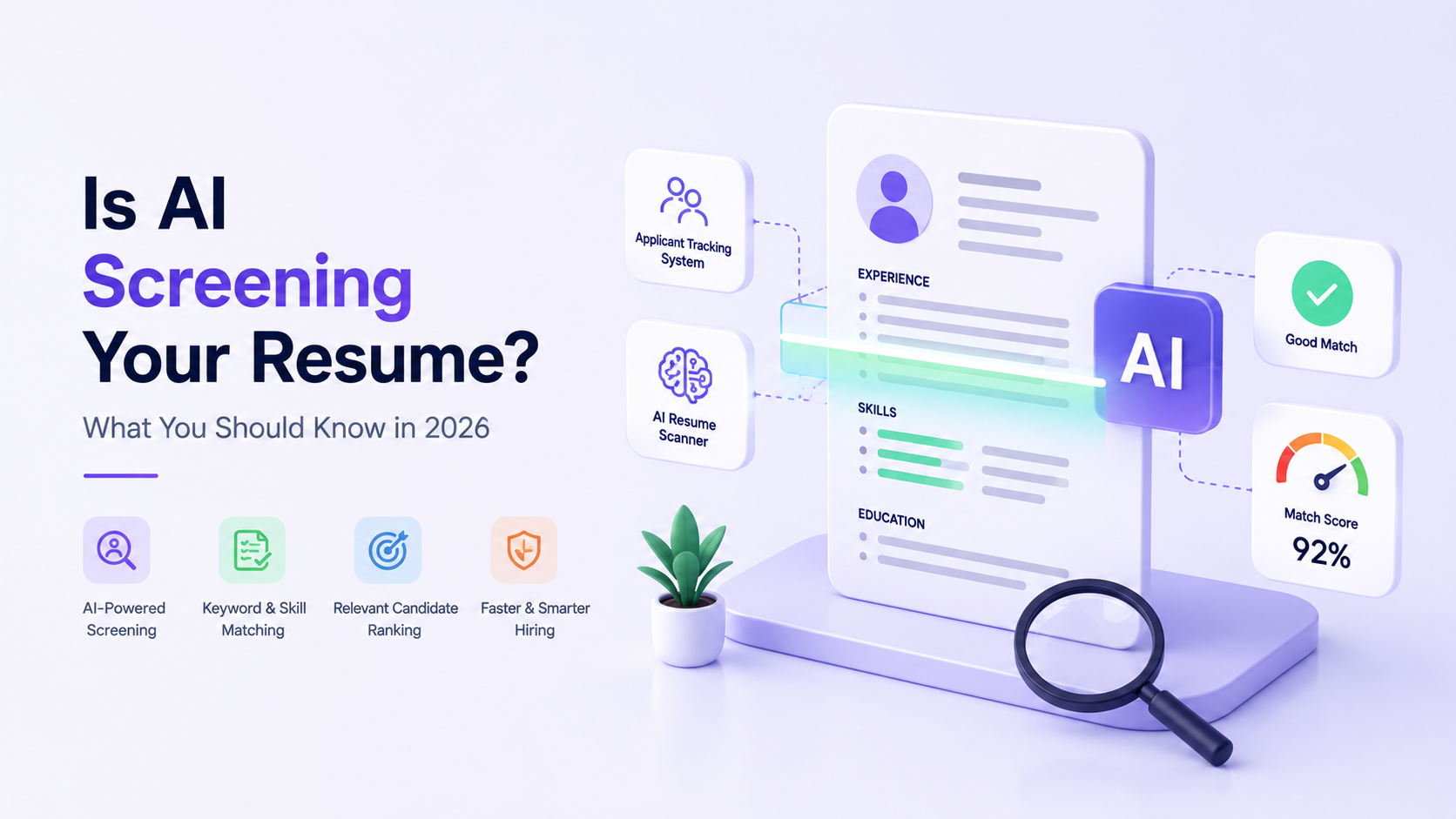
You submit a resume online, and it disappears into a portal. No confirmation, no visible reviewer, just a status that eventually changes to “not selected.” It is natural to wonder whether a person ever looked at it or whether some algorithm quietly filtered it out before a human got the chance.
The honest answer is more complicated than either “AI rejected you” or “nothing changed.” AI resume screening is real, it is increasingly common, and it works differently depending on the employer, the software they use, and how their hiring team has configured it.
Direct Answer
Can AI screen your resume? Often, yes, in some form. Many employers use software to organize, parse, search, rank, or assist with evaluating applications, and some of that software includes AI features. However, the exact role AI plays, if any, varies significantly between companies, industries, and the specific hiring systems in use.
Key Takeaways
-
AI resume screening is not one universal system. It ranges from simple keyword search to more advanced AI-assisted ranking, and it varies by employer.
-
An applicant tracking system (ATS) is not automatically the same thing as an AI system. Many ATS platforms rely on basic parsing and search rather than AI decision-making.
-
Keywords matter because they often reflect real job requirements, not because stuffing a resume with terms guarantees a match.
-
No publicly available information supports the idea that AI alone makes final hiring decisions. Human review remains part of most processes.
-
AI struggles to reliably interpret context, career changes, and nontraditional experience the way a person can.
-
Clear structure and honest, specific content help both software and human recruiters understand a resume.
-
The goal is relevance and clarity, not trying to outsmart a screening system.
What Is AI Resume Screening?
AI resume screening refers to the use of artificial intelligence to assist with tasks involved in reviewing job applications. It is not a single product or a fixed process. Depending on the employer, AI may be used to assist with:
-
Extracting information from a resume, such as job titles, dates, and skills
-
Identifying relevant skills or qualifications mentioned in the text
-
Comparing a candidate’s stated experience with the requirements in a job description
-
Organizing candidate information into searchable profiles
-
Supporting candidate matching or ranking within a larger applicant pool
-
Helping recruiters process high volumes of applications more efficiently
Some employers use AI extensively across these tasks. Others use very little automation and rely mainly on a database with basic search functions. Because hiring technology is not standardized across companies, it is inaccurate to describe AI resume screening as a single, predictable process that behaves the same way everywhere.
AI Resume Screening vs Applicant Tracking Systems
This distinction gets confused often, and it matters.
An applicant tracking system, or ATS, is software that helps employers manage job postings and applications. At its core, an ATS is a database. It stores resumes, tracks candidates through hiring stages, and lets recruiters search and filter applications. Many ATS platforms have existed for years and were not originally built around AI at all. Their basic functions, storing data and enabling keyword search, do not require artificial intelligence.
Resume parsing is a related but separate function. Parsing software reads a resume and extracts structured data, such as your name, work history, education, and skills, and converts it into a format the ATS database can store and search. Parsing can use simple pattern recognition or more advanced AI-based language processing, depending on the tool.
Keyword matching is often layered on top of parsing. A recruiter or the system itself may search for specific terms from the job description, such as a required certification or software skill, and use those matches to filter or sort candidates.
Candidate ranking is where AI becomes more directly relevant. Some modern ATS platforms and separate AI recruitment tools use machine learning to score or rank candidates based on how closely their profile appears to match a role, drawing on more signals than simple keyword presence.
Human review still typically follows some form of automated sorting in most hiring processes, though the point at which a person becomes involved, and how much weight they give to any automated score, depends entirely on the employer’s process.
The practical takeaway: using an ATS does not mean a company uses AI. Some do, many use only basic parsing and search, and a smaller number use more advanced AI-assisted ranking. Assuming every online application funnels through a sophisticated algorithm is not accurate.
How AI May Analyze a Resume
When AI or automated parsing is involved, the factors it may look at typically include:
-
Job titles and how closely they align with the target role
-
Skills mentioned, both technical and soft skills
-
Work experience, including responsibilities and duration
-
Education and relevant certifications
-
Terminology that matches or closely relates to language in the job description
-
Overall resume structure, including how clearly sections are labeled
-
Dates and the general shape of a career history, such as gaps or progression
Different employers and different software systems can weigh these factors differently. A recruitment tool built for technical hiring may focus heavily on specific tools and certifications. A system used for customer-facing roles may weight communication-related language more heavily. There is no single, universal algorithm that all systems share, and no publicly documented formula that applies across every employer’s hiring stack.
What Information Can Resume Screening Systems Look At?
Screening systems generally only have access to what is written in the resume, cover letter, and any additional application fields the employer requests. They do not have independent knowledge of your actual skill level, work quality, or character. This is an important limitation to keep in mind throughout the rest of this guide: whatever a system concludes is based entirely on how clearly and accurately your experience is described in text.
How Keywords Actually Affect Resume Screening
Job descriptions usually contain meaningful information about what an employer is looking for: required skills, tools, certifications, responsibilities, and the terminology used within that industry or role. When a resume naturally reflects that same language, because the candidate genuinely has that experience, it can help both automated systems and human recruiters recognize a strong match more easily.
This is different from keyword stuffing. Copying every term from a job posting into a resume, regardless of whether it reflects real experience, does not accurately represent your background and can create problems rather than solve them.
A realistic example: Suppose a job description asks for experience with “cross-functional project coordination” and “stakeholder communication.” Instead of adding those exact phrases in a skills list without context, a candidate with genuine relevant experience might write: “Coordinated a product launch across engineering, marketing, and sales teams, communicating timeline changes directly to stakeholders on a weekly basis.” This naturally includes the relevant concepts and terminology while describing real, specific work.
Why Keyword Stuffing Can Hurt Your Resume
Several problems can result from keyword stuffing:
-
It can make a resume read awkwardly or unnaturally to a human reviewer, even if it technically contains the right terms.
-
Repeating the same phrase multiple times without context does not necessarily improve how a system evaluates relevance, and some systems may flag unnatural repetition.
-
Hidden keywords, such as white text or tiny font tricks, are widely discouraged and can be flagged as an attempt to manipulate a system rather than represent genuine qualifications.
-
Listing skills you do not actually have creates a mismatch that becomes obvious during an interview or on the job, regardless of whether it passed an initial screen.
The goal is relevance and clarity, describing your actual experience using the terminology that genuinely applies to it, not maximizing keyword density.
How to Make Your Resume Easier for AI and Recruiters to Understand
Use a Clear Resume Structure
Use standard section headings such as “Experience,” “Education,” “Skills,” and “Certifications.” Clear, predictable structure helps both parsing software and human readers quickly locate the information they need.
Match Your Experience to the Job Requirements
Read the job description carefully and identify the specific responsibilities and qualifications it emphasizes. Reflect your genuinely relevant experience in a way that speaks directly to those requirements, rather than submitting an identical, generic resume for every application.
Use Relevant Skills and Terminology Naturally
Include the hard and soft skills you actually possess, described in language consistent with how the industry or role typically refers to them. If a job description uses both an acronym and its full form, such as “search engine optimization (SEO),” including both versions somewhere in your resume can help address different parsing approaches.
Avoid Unnecessary Formatting Problems
Complex tables, text boxes, columns, images, and unusual fonts can sometimes be misread by parsing software, which may scramble or drop information. When applying through an online system, simpler formatting is generally safer, even though it may look less visually distinctive.
Focus on Specific Experience and Achievements
Vague descriptions like “responsible for various tasks” give both software and human readers little to work with. Specific, accurate descriptions of what you did and the outcome, where you can honestly quantify it, communicate your value far more clearly.
None of these practices guarantee that a resume will be selected. They are aimed at making a resume easier to understand accurately, which is a realistic and controllable goal.
Can AI Automatically Reject Your Resume?
This is one of the most common concerns job seekers have, and it deserves a careful answer.
Automation may be used to filter, sort, or prioritize applications in some hiring processes. This means it is possible for a resume to be deprioritized or filtered out by a system before a person reviews it in some cases. However, this does not mean that every rejection is caused by an algorithm, and it does not mean this happens the same way at every company.
Several factors affect hiring outcomes beyond any automated system:
-
The volume of applications a role receives, which affects how much attention each one gets
-
Whether the employer uses any automated filtering at all
-
The specific qualifications and requirements for the role
-
Internal hiring policies, timelines, and priorities
-
Human judgment at whatever stage a person becomes involved
A resume that is not selected may reflect a mismatch with the role’s specific requirements, a highly competitive applicant pool, timing, internal referral practices, or a range of other ordinary hiring dynamics that have nothing to do with automated rejection. It is not accurate to assume that every unsuccessful application was automatically filtered by AI.
Resume screening is only one piece of a larger job search process, and pairing a clear resume with a broader search strategy, including AI tools to find a job, tends to matter more than optimizing for any single system.
What AI Resume Screening Systems Cannot Reliably Understand
Even where AI is involved, there are real limitations worth understanding:
Context. A resume can accurately list skills and job titles without conveying the full context of what a candidate actually accomplished or how they approached challenges.
Career changes. Someone shifting industries may have highly relevant transferable skills that are not phrased in the exact terminology a system expects, since their background comes from a different field.
Unusual career paths. Nonlinear career histories, employment gaps for legitimate reasons, or unconventional combinations of experience can be harder for automated systems to categorize neatly, even when the underlying experience is strong.
Transferable skills. A skill developed in one context, such as project management learned through volunteer work or a different industry, may not be recognized as equivalent by a system looking for specific keywords tied to a particular field.
Quality of experience. Automated systems can identify that a candidate held a certain job title for a certain duration. They are far less equipped to judge the quality, complexity, or impact of that work.
The gap between keyword matching and actual suitability. A resume can score well on keyword relevance while still being a poor fit for a role’s actual day-to-day demands, and the reverse is also true.
This is precisely why clear, honest communication in a resume remains valuable regardless of what technology reviews it first. Describing your real experience accurately gives both software and the eventual human reviewer the best chance of understanding your genuine fit.
Common Mistakes Job Seekers Make When Optimizing for AI
-
Keyword stuffing instead of naturally reflecting real experience
-
Listing skills or tools the candidate does not actually have
-
Copying entire phrases or paragraphs directly from the job description
-
Using overly complicated formatting that risks being misread by parsing software
-
Writing vague, generic descriptions instead of specific, accurate ones
-
Using AI-generated resume text without checking it for accuracy
-
Submitting the exact same resume for every application regardless of role differences
-
Assuming software is the only audience and ignoring how the resume reads to a person
-
Trying to manipulate or “trick” a screening system rather than focusing on genuine clarity and relevance
Can AI Help You Improve Your Resume Before Applying?
Yes, within reasonable limits. AI tools can assist with several parts of the resume preparation process, including:
-
Identifying missing information or sections that a resume should probably include
-
Comparing a resume against a specific job description to highlight gaps or mismatches
-
Improving clarity, structure, and readability
-
Generating ideas for how to phrase a description of your experience
-
Rewriting bullet points or summaries in a more direct or professional tone
-
Checking overall resume structure and formatting
Understanding how AI screening may work is different from the question of which tools can help you write or refine a resume. If you are specifically looking for that kind of support, a separate resource on this site examines AI resume tools in more depth.
Whatever a tool generates, the responsibility for accuracy remains yours. You should personally verify:
-
That every skill listed reflects genuine ability
-
That work experience and achievements are described accurately
-
That dates, job titles, and employers are correct
-
That any claims about outcomes or results can be honestly supported
Never submit AI-generated resume content without reviewing and confirming it reflects your actual background. A polished resume that overstates your qualifications tends to create problems later in the hiring process, not fewer.
How to Use AI Resume Tools Responsibly
A few practical principles help keep AI assistance useful rather than risky:
-
Treat AI suggestions as a starting point, not a final answer.
-
Compare any AI-generated wording against your actual experience before including it.
-
Use AI to identify gaps or weak phrasing, then rewrite in your own voice.
-
Avoid letting an AI tool add skills, tools, or achievements you have not actually used or accomplished.
-
Keep a master version of your resume with fully verified information, and adapt from that master copy for each application.
This approach lets you benefit from AI’s speed and pattern recognition while keeping the final content honest and specific to you.
AI Resume Screening Checklist
Use this list before submitting an application:
-
Does the resume use clear, standard section headings?
-
Does the experience section describe specific responsibilities and outcomes, not vague generalities?
-
Have you reviewed the job description and reflected genuinely relevant skills and terminology?
-
Have you avoided repeating the same keyword unnaturally multiple times?
-
Are all listed skills ones you can honestly demonstrate if asked?
-
Is the formatting simple enough to be read correctly by parsing software, avoiding complex tables or text boxes?
-
Are your dates, job titles, and employer names accurate and consistent?
-
If you used an AI tool to help draft or revise content, have you checked it for accuracy against your real background?
-
Is the resume tailored to this specific role rather than a generic, one-size-fits-all version?
Final Thoughts
AI resume screening exists, and it plays some role in many hiring processes, but not in the uniform, all-powerful way it is sometimes portrayed. Applicant tracking systems, resume parsers, keyword matching, and AI-assisted ranking are related but distinct technologies, and how much any employer relies on them varies widely. What remains consistently useful, regardless of which systems a particular employer uses, is a resume that clearly and honestly communicates your real experience in language relevant to the role you want.
Trying to outsmart an unknown algorithm is a weaker strategy than simply making your qualifications easy to understand for software and for the person who eventually reads it. That focus on clarity and genuine relevance is the one approach that holds up across every kind of hiring process, automated or not. For readers looking to place resume optimization within a wider job search workflow, a related guide on AI job search tools covers additional practical strategies beyond the resume itself.