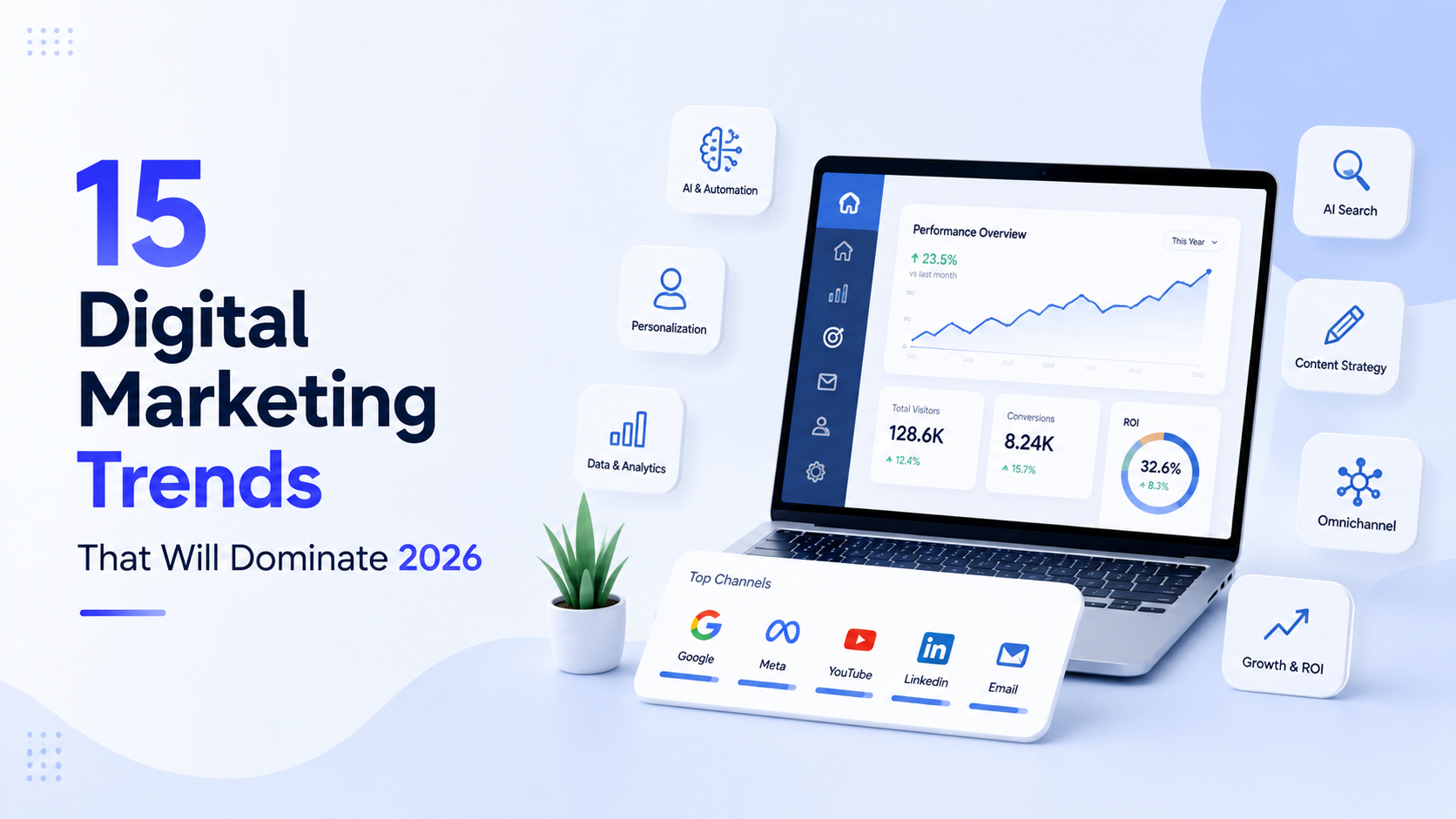
Marketing teams spent the last two years reacting to AI tools as they appeared. In 2026, the reaction phase is over. What separates growing businesses from stagnant ones is no longer whether they use AI, but how they structure data, content, distribution, and human judgment around it.
This article breaks down the strategic shifts behind digital marketing trends in 2026, not just the buzzwords attached to them.
Direct Answer
The digital marketing trends of 2026 businesses need to prioritize centering on three shifts: AI systems becoming a genuine discovery channel alongside search engines, first-party data and human expertise becoming harder to replicate than AI access itself, and measurement moving away from traffic toward revenue. Marketers who adapt their content, data, and workflows around these shifts will outperform competitors who simply adopt more AI tools without changing strategy.
Key Takeaways
- AI access is becoming commoditized; the advantage now comes from workflow design, proprietary data, and editorial judgment.
- Search visibility increasingly includes AI-generated answers, not only blue-link rankings.
- First-party data and direct audience relationships are replacing dependence on rented platforms.
- Traffic is a weaker metric than qualified leads and revenue attribution.
- Content distribution now matters as much as content production.
- Brand authority influences whether AI systems recommend a business at all.
Why Digital Marketing Is Changing in 2026
Three forces are reshaping strategy simultaneously. First, generative AI tools like ChatGPT, Gemini, and Google AI Overviews now answer questions directly, which changes how people discover businesses. Second, privacy regulation and the decline of third-party cookies have pushed marketers toward first-party data collection. Third, AI-generated content has become so widespread that generic content no longer differentiates anyone, which makes human expertise and original data more valuable, not less.
None of these forces are temporary. They are structural, and they explain why the digital marketing trends 2026 conversation looks different from prior years’ trend lists.
1. AI Search Is Becoming a Core Marketing Channel
What is changing: Google AI Overviews, ChatGPT, Perplexity, and Gemini now generate direct answers instead of only listing links. Users increasingly get information without visiting a website.
Why it’s happening: These systems are trained to synthesize the most credible, well-structured information available rather than send users elsewhere.
Why businesses should care: If your content isn’t structured to be cited by these systems, you can lose visibility even while ranking well in traditional search.
Who should adopt it: Any business relying on organic search for leads.
How to apply it: Structure content with clear definitions, direct answers, and well-organized sections that AI systems can extract cleanly. Google AI Overviews Explained
What to avoid: Writing exclusively for keyword density instead of clarity.
Next 12 months: Expect AI-generated answers to account for a growing share of informational queries, making citation-worthy content a measurable goal, not an afterthought.
2. AI Is Becoming Marketing Infrastructure
AI tools are no longer a differentiator; they’re becoming table stakes, similar to email or analytics platforms. Every competitor has access to the same writing assistants, ad optimization tools, and chatbots.
The real advantage comes from what AI cannot replicate: proprietary customer data, original research, brand voice, and human quality control over outputs. Businesses that treat AI as infrastructure, built into workflows with human oversight, will outperform those treating it as a shortcut.
Who should adopt it: Marketing teams building repeatable processes, not one-off content.
Avoid: Publishing unedited AI output at scale. Search engines and audiences both penalize it.
3. Human Expertise Is Becoming a Competitive Advantage
As AI-generated content floods every niche, unedited generic content is losing value fast. Original opinions, tested advice, and named expertise are becoming rarer and therefore more valuable.
This matters because Google’s helpful content systems and AI models both favor content demonstrating real experience. Businesses should invest in subject-matter experts reviewing or authoring content, not just prompting AI and publishing.
Who should adopt it: B2B companies, agencies, and niche experts where trust drives conversions.
Watch for: Author credibility signals becoming a more visible ranking and citation factor.
4. First-Party Data Is Becoming More Valuable
Third-party cookie restrictions and privacy regulations have made rented audience data less reliable. Email lists, CRM data, and direct customer relationships are becoming the most dependable assets a business owns.
Why businesses should care: Paid acquisition costs are rising while ad targeting precision declines. Owned data reduces this dependency.
How to apply it: Build lead magnets, loyalty programs, and direct communication channels that collect consented data.
Avoid: Treating data collection as a compliance checkbox rather than a strategic asset.
5. Personalization Is Moving From Segments to Individual Journeys
Segment-based personalization, showing the same message to “young professionals” or “returning customers,” is giving way to journey-based personalization powered by behavioral data and AI.
Why it matters: Customers now expect messaging that reflects their specific actions, not broad demographics.
Example: An e-commerce brand adjusting email content based on browsing behavior in the last 48 hours, rather than a static monthly newsletter.
Who should adopt it: Businesses with enough first-party data volume to act on individual signals. Smaller businesses should focus on trend 4 first.
6. Search Is Becoming Conversational and Multimodal
Search queries are shifting from short keyword phrases to full questions, voice input, and image-based search. Google Search Central and Microsoft’s Bing documentation both confirm growing support for conversational and visual queries.
Why businesses should care: Content built only around short keywords misses a growing share of how people actually ask questions.
How to apply it: Write content that answers full questions naturally, and ensure images are optimized with descriptive context. Search Intent vs. User Intent
7. Zero-Click Visibility Is Becoming a Marketing Goal
A meaningful share of searches now end without a click, because the answer appears directly in search results or AI overviews. Chasing clicks alone ignores this reality.
Why it matters: Brand impressions and citations within AI answers still build awareness and trust, even without a visit.
What businesses should do: Track brand mentions and citations in AI answers alongside traditional traffic metrics, rather than treating zero-click impressions as failure.
Avoid: Judging content success purely by click-through rate.
8. Brand Authority Matters More in AI-Powered Search
When someone asks ChatGPT or Gemini, “What’s the best CRM for small businesses?” the model recommends brands it associates with credibility and consistent mentions across the web, not necessarily the highest bidder.
Why it’s happening: AI models weigh consistency of brand mentions, reviews, and third-party validation when generating recommendations.
How to apply it: Invest in digital PR, credible reviews, and consistent brand mentions across reputable sites, not just your own domain.
9. Content Repurposing Is Becoming a Distribution Strategy
Producing new content constantly is less efficient than distributing existing content across more formats and channels. One well-researched article can become a video script, a LinkedIn post, an email sequence, and a short-form clip.
Why businesses should care: Distribution now determines reach as much as content quality does.
Who should adopt it: Lean teams and solo creators who can’t sustain constant original production.
Avoid repurposing without adapting tone and format to each platform’s audience expectations.
10. Marketing Automation Is Moving Toward AI-Assisted Workflows
Automation platforms like HubSpot and Meta’s ad tools are embedding AI directly into workflows: automated segmentation, predictive lead scoring, and dynamic ad creative generation.
Why it matters: Manual rule-based automation is being replaced by adaptive systems that learn from performance data continuously.
How to apply it: Audit current automation for opportunities where AI-assisted decisioning can replace static rules, particularly in lead scoring and ad bidding.
Avoid: Letting automation run unsupervised without regular human review of outputs and edge cases.
11. Short-Form Video Is Shifting From Reach to Searchable Discovery
Platforms including YouTube, TikTok, and Instagram are increasingly indexed as search engines, with users searching directly within these apps for answers and recommendations.
Why businesses should care: Short-form video now needs to be optimized for on-platform search, not just algorithmic reach.
How to apply it: Use clear, question-based titles and spoken keywords within videos, since some platforms transcribe and index speech.
12. Community and Direct Audiences Are Becoming More Important
Businesses are shifting effort toward owned communities, newsletters, and direct messaging channels rather than relying entirely on social platform algorithms that can change reach overnight.
Why it’s happening: Algorithm volatility on social platforms has made organic reach unpredictable.
Who should adopt it: Creators and brands with engaged niche audiences.
Avoid: Abandoning social platforms entirely; use them for discovery while building direct relationships in parallel.
13. Marketing Measurement Is Moving Closer to Revenue
Traffic, impressions, and engagement are increasingly treated as leading indicators rather than success metrics. Marketing ROI is being tied directly to pipeline and revenue data through better CRM integration.
Why businesses should care: Budget decisions increasingly depend on demonstrating revenue impact, not vanity metrics.
How to apply it: Connect analytics platforms to CRM and sales data so marketing performance ties to closed revenue, not just top-of-funnel numbers.
14. Omnichannel Experiences Are Becoming More Connected
Customers move between search, social, email, and in-store or app experiences within a single buying decision. Disconnected channel strategies create friction and lost conversions.
How to apply it: Ensure messaging, offers, and customer data stay consistent whether a customer interacts via email, ads, or a physical location.
Who should adopt it: Retail, hospitality, and multi-location service businesses, especially.
15. The Best Marketing Strategy Is Becoming More Human, Not Less
As AI handles more production tasks, the businesses that stand out are the ones amplifying human judgment: original opinions, real customer stories, and visible expertise, rather than removing people from the process entirely.
This is the thread connecting nearly every trend on this list. Access to AI is no longer scarce. Human insight, applied well, is.
How Businesses Should Prioritize These Trends
Not every business needs to act on all 15 trends immediately. Prioritization depends on business size, industry, and current marketing maturity.
| Business Type | Priority Trends |
|---|---|
| Small business / local service | First-party data, brand authority, community building |
| Ecommerce | Personalization, zero-click visibility, omnichannel |
| B2B / agencies | Human expertise, AI search, revenue measurement |
| Content creators / bloggers | Content repurposing, short-form video, AI search |
Digital Marketing Trends 2026: What Should You Act on First?
Act Now: First-party data collection, human expertise in content, AI search optimization, and revenue-based measurement.
Test Next: AI-assisted automation workflows, individual-level personalization, and short-form video for discovery.
Monitor: Multimodal and voice search adoption rates, omnichannel integration maturity, and community platform shifts.
This framework matters because businesses attempting all 15 digital marketing trends in 2026 at once typically execute none of them well. Sequencing based on current capability produces better results than trying to do everything simultaneously.
Final Thoughts
The businesses that will lead in 2026 aren’t the ones with the most AI tools. They’re the ones combining AI infrastructure with genuine expertise, owned data, and consistent brand credibility across every channel where customers now search, ask, and decide.
Understanding digital marketing trends in 2026 is less about tracking new technology and more about recognizing which foundations, data, expertise, and distribution actually compound over time. Businesses that build on those foundations now will have a structural advantage that’s difficult for competitors to copy later. WordPress SEO in 2026