Ask ChatGPT to summarize a report, and it hands you a summary. Ask an AI agent to prepare a competitor analysis, and it searches the web, visits company pages, pulls pricing, organizes the findings, and gives you a finished document. The difference is not intelligence. It is what the system is allowed to do after it finishes thinking.
That distinction, answering versus acting, is the entire story behind the sudden interest in AI agents. The term gets attached to everything from a simple chatbot with a memory feature to genuinely autonomous systems that run multi-step workflows without supervision. Not all of it deserves the label, and understanding the difference is what actually matters if you are deciding whether to use one.
Direct Answer
An AI agent is a software system built on a large language model that can receive a goal, break it into steps, use tools such as web search, APIs, or code execution to complete those steps, check its own results, and continue working until the task is finished or it needs human input.
Key Takeaways
-
An AI agent acts on a goal across multiple steps. A chatbot responds to a single prompt and stops.
-
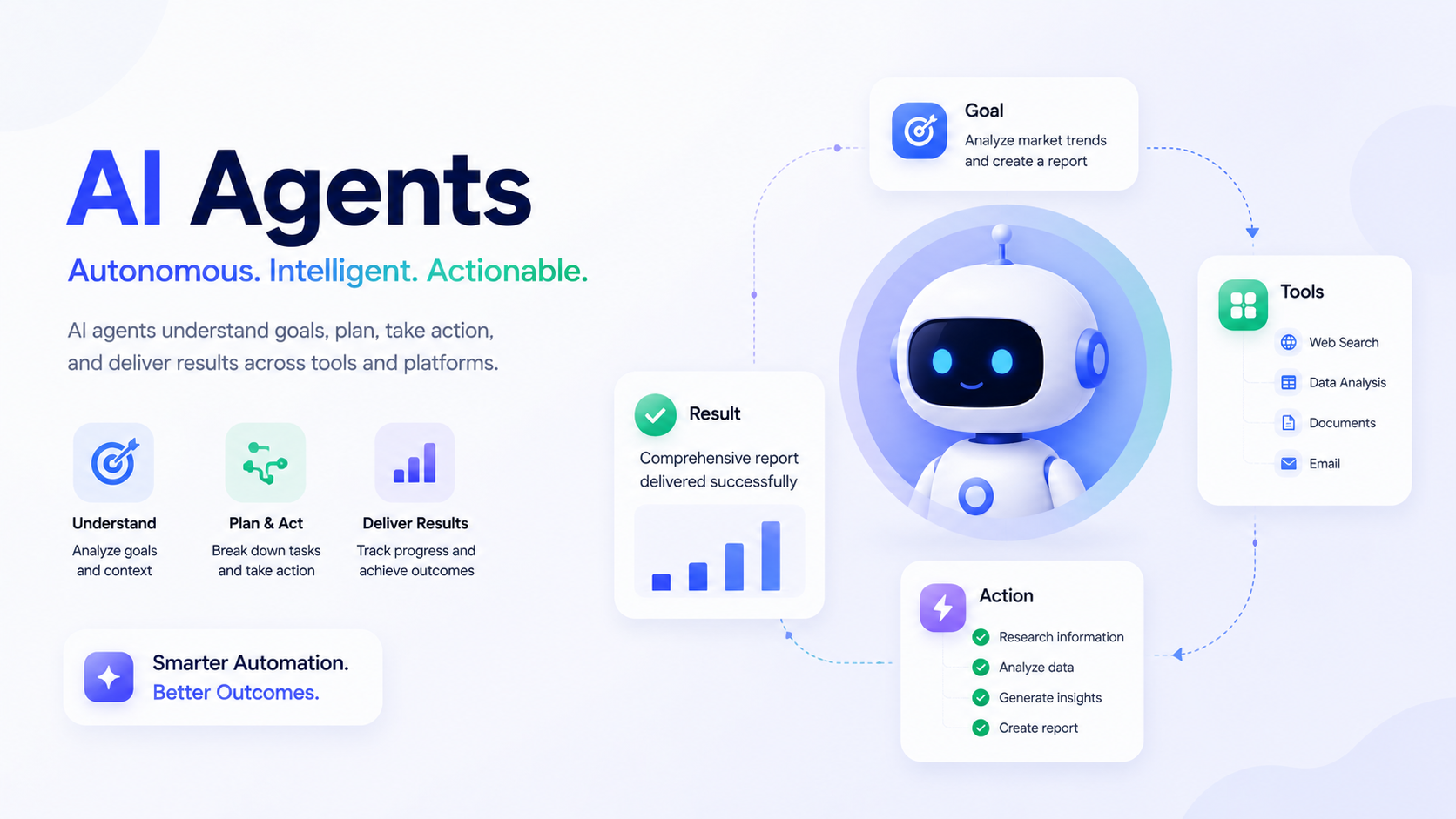
The core loop behind most agents is goal, plan, tool use, action, check, and result, repeating until the task is done.
-
Not every product marketed as an AI agent has the same level of autonomy. Some ask for approval at every step; others run largely unsupervised.
-
Tool use, memory, and reasoning are the three components that separate an agent from a standard chatbot.
-
Agents are genuinely useful for repetitive, multi-step tasks with clear success criteria, such as research, ticket triage, or data analysis.
-
Agents still struggle with ambiguous goals, judgment calls, and situations that fall outside their training or tool access.
-
The more autonomy an agent has, the more it needs permission limits, logging, and human review, not less.
What Is an AI Agent?
An AI agent is a system that takes a goal, works out a plan to reach it, and carries out that plan using tools, without needing a human to approve every individual step. The large language model inside the agent supplies the reasoning: understanding the goal, deciding what to do next, and interpreting results. The tools supply the ability to actually do something, like searching the web, calling an API, reading a file, or running code.
This matters because an LLM by itself cannot act. It can only generate text. GPT, Claude, or Gemini answering a question in a chat window is reasoning without action. Wrap that same model in a system that gives it tools, a way to track what it has already done, and a loop that keeps it working toward a goal, and you have something functionally different: an agent.
Autonomy is not binary. Some agents pause and ask for confirmation before anything risky, like sending an email or making a purchase. Others run through an entire multi-step task, such as researching a topic and drafting a report, without checking in at all. Both are legitimately called agents, but they carry very different levels of trust and risk, which is why it matters to ask how much independence a specific tool actually has before relying on it.
How AI Agents Actually Work
Most AI agents, regardless of the framework behind them, follow some version of the same loop:
-
Goal. The agent receives an objective, either from a person or from another system.
-
Plan. The reasoning engine, the LLM, breaks the goal into a sequence of steps.
-
Tools. The agent selects a tool suited to the current step, such as a search function, a database query, or a code interpreter.
-
Action. The agent executes the chosen tool and receives a result.
-
Check. The agent evaluates whether that result actually moves it toward the goal or whether something unexpected happened.
-
Result. The agent either continues to the next step, revises its plan, or delivers the finished output. If it hits something it cannot resolve, it hands the task back to a human.
Here is what that looks like with a specific task: “research our three main competitors and summarize their pricing.”
The agent first plans a sequence: find competitor names, locate their pricing pages, extract the numbers, and write a summary. It runs a web search to identify the competitors, then visits each company’s site using a browsing tool to pull pricing details. If one competitor does not publish pricing publicly, a well-built agent notes that gap rather than guessing a number. Once it has gathered what it can, it drafts the comparison and checks whether the draft actually answers the original request before handing it back.
The loop matters because tasks rarely go exactly as planned. A search returns nothing useful, an API call fails, and a page does not load. An agent that can observe a failed step and try a different approach is far more useful than a fixed script that breaks the moment something unexpected happens. That adaptability, not raw intelligence, is the actual innovation.
Not every agent plans the entire task upfront. Some generate a full plan before acting; others decide only on the next single step and revise continuously based on what happens. Dynamic, step-by-step planning tends to handle real-world messiness better, since a rigid upfront plan breaks the moment reality diverges from what it expected.
AI Agent vs Chatbot vs AI Assistant vs Automation
These four terms get used interchangeably in marketing material, which is part of why “AI agent” has become confusing. They are not the same thing.
| Type | Primary Purpose | Plans Multi-Step Tasks | Uses External Tools | Level of Autonomy | Typical Use Case |
|---|---|---|---|---|---|
| AI Agent | Complete a goal across multiple steps | Yes. | Yes, often several | Moderate to high | Research automation, multi-step workflows, ticket resolution |
| Chatbot | Answer a question or hold a conversation. | No | Rarely, or none | Low, responds per message | FAQ answering, basic customer queries |
| AI Assistant | Help with a specific task inside one tool or workflow | Limited, within one context | Usually one integrated tool | Low to moderate | Writing suggestions, inbox drafting, scheduling |
| Traditional Automation | Execute a fixed, predefined sequence. | No, it follows fixed rules. | Yes, but only pre-configured ones. | None, follows rules exactly | Trigger-based workflows, if this then that automations |
| Generative AI | Produce text, images, or other content from a prompt. | No | No | None | Drafting content, generating images, summarizing text |
The clearest test: does the system decide what to do next based on the outcome of its previous action, or does it follow a fixed script regardless of what happens? A Zapier-style workflow that fires an email when a form is submitted is automation. It does not reason about whether the email still makes sense given new information. An agent that reads an incoming support ticket, decides it needs more context, pulls the customer’s order history, and only then drafts a response is doing something categorically different, even though both might be described as “automated.”
The Core Components of an AI Agent
A working agent is built from a handful of parts that each play a distinct role.
Reasoning. The LLM at the center of the system interprets the goal, decides what step comes next, and makes sense of whatever the tools return. This is the part doing the actual thinking.
Planning. The process of breaking a large goal into smaller steps and revising that plan when something unexpected happens. A plan made once and never revisited tends to fail the first time reality does not match expectations.
Tool use. Tools are how the agent actually affects anything outside of generating text. This includes calling APIs, browsing the web, querying a database, running code, or writing to a file. Without tools, an LLM can only talk about a task, not perform it.
Memory and context. Memory lets an agent remember what it already tried, what worked, and what failed, so it does not repeat the same mistake or lose track of progress partway through a long task. Context is the information available to the model at any given moment, which is limited, so agents need to manage what gets included carefully.
Human approval. Many well-designed agents pause at defined checkpoints, particularly before irreversible actions like sending a payment or deleting data, and wait for a person to confirm before proceeding.
Multi-agent coordination. Some tasks are split across several specialized agents rather than handled by one system trying to do everything. A research agent might hand its findings to a writing agent, which hands the draft to a review agent. Newer standards like the Model Context Protocol, created by Anthropic and now governed by the Linux Foundation, and Google’s Agent-to-Agent protocol have emerged specifically to let agents built by different teams connect to tools and to each other without custom integration work for every combination. These matter mainly at the infrastructure level, but they are part of why agent adoption has accelerated: connecting an agent to a new tool or another agent no longer requires bespoke code every time.
What Can AI Agents Actually Do?
The realistic answer, without exaggeration, covers several categories of work that are repetitive, multi-step, and have a checkable outcome.
An AI agent researching competitors and preparing a report. It searches for competitor names, visits their websites and pricing pages, extracts relevant details, and compiles a structured comparison, flagging where information is unavailable rather than inventing it.
An AI agent handling customer support tickets. It reads an incoming ticket, checks the customer’s order or account history through a connected system, determines the likely resolution, and either responds directly or escalates to a human when the situation involves a refund, complaint, or ambiguous request.
An AI agent analyzing marketing data. It pulls performance numbers from an ad platform or analytics tool, identifies which campaigns are under or overperforming against a defined target, and produces a summary highlighting where budget should shift.
An AI agent researching keywords and identifying content opportunities. It queries search data, checks what is already ranking for a given topic, compares that against existing content on a site, and flags topics with genuine gaps rather than simply listing keyword volume.
An AI agent helping developers debug code. It reads an error message, examines the relevant files, proposes a fix, runs the test suite, and iterates if the tests fail, rather than suggesting a single untested guess.
An AI agent organizing information from multiple sources. It pulls data from documents, spreadsheets, and databases scattered across different systems and consolidates them into one usable format.
An AI agent coordinating a multi-step business workflow. It might process an incoming invoice, match it against a purchase order, flag discrepancies, and route it for approval, chaining several tools together to complete a task that previously required a person moving information between systems by hand.
In each case, the agent is not simply “automating” the task in the vague sense that phrase usually implies. It is making a series of specific decisions, using specific tools, and adjusting when something does not go as expected.
Real-World AI Agent Examples
Beyond the categories above, agent-based systems are already operating in several visible settings. Coding assistants with agent modes now read an entire codebase, make changes across multiple files, run the test suite, and fix failures on their own before presenting a finished change for review, rather than only suggesting the next line as you type. Customer service systems are built so agents can check an order status, initiate a return, or reschedule an appointment directly, instead of only answering questions about the process. Research-oriented agents can be given an open-ended question and will search, cross-reference sources, and compile a written answer with citations, adjusting their search strategy if the first attempt returns weak results.
These examples share a pattern: a defined goal, access to relevant tools, and a way to check whether the output is actually correct before finishing.
Where AI Agents Are Most Useful
Agents perform best on tasks that are repetitive, multi-step, and have a way to check whether the outcome is correct. Research tasks, data collection, first-pass customer support, code debugging, and workflow coordination between existing systems all fit that description well. These are jobs where the steps are fairly predictable even if the specific content varies each time.
They are also a good fit where the cost of a mistake is low and recoverable, or where a human review step is built in before anything final happens. A marketing team using an agent to draft a first pass at a content brief, with a person reviewing before publishing, gets real-time savings without meaningful risk.
Where AI Agents Still Struggle
Agents do not handle ambiguous goals well. If the objective is vague, “improve our marketing,” the agent has no clear way to check whether it succeeded, and it may confidently produce something that misses the actual intent.
They also struggle with genuine judgment calls, situations requiring context the agent was never given, or decisions with real consequences that depend on factors outside its training and tool access, such as a legal gray area or a sensitive customer relationship. Hallucination, where the model states something false with confidence, remains a real risk, particularly when an agent is asked to fill in a gap rather than report that the information is unavailable. Tool failures compound this: if a connected API returns bad data and the agent does not catch it, the error propagates into whatever it produces next.
Multi-agent systems introduce their own failure mode. When one agent hands a flawed result to another, the mistake can cascade through the whole workflow before a human notices, since no single agent may be positioned to catch an error made earlier in the chain.
Are AI Agents Safe?
Agents are as safe as the permissions and oversight built around them, not inherently safe or unsafe on their own. The core principle worth remembering: the more power an agent has to take real action, the more important permissions, monitoring, testing, logging, and human approval become, not less.
The specific risks worth taking seriously include incorrect actions taken with confidence, hallucinated information presented as fact, tool misuse where the agent calls the wrong function or with wrong parameters, excessive permissions that let an agent do far more than the task requires, privacy exposure when an agent has access to sensitive data it does not need, security vulnerabilities such as prompt injection, where malicious instructions hidden in a webpage or document get treated as legitimate commands, and simply unexpected behavior that nobody anticipated when the system was designed.
None of this means agents should be avoided. It means the deployment matters as much as the technology. An agent given read-only access to a calendar and asked to suggest meeting times carries very little risk. The same agent given the ability to send emails, make purchases, or modify a production database on its own needs scoped permissions, a full log of every action taken, and a human checkpoint before anything irreversible happens.
How Businesses Can Start Using AI Agents
Starting small and specific works far better than attempting a fully autonomous system on day one.
-
Pick one repetitive task with a clear, checkable outcome, not the most ambitious one available.
-
Give the agent access to only the tools and data it actually needs for that task.
-
Build in a human review step for anything that would be costly to get wrong.
-
Track what the agent actually does over time, including where it fails, before expanding its scope.
-
Increase autonomy gradually as the agent proves reliable on the narrower task.
A small business trying an agent for the first time gets more value from something narrow, like drafting first-response replies to common support questions for a human to review, than from an ambitious attempt to automate an entire customer service department at once. Reviewing how the underlying models are being used for research and content, including tools that assist with structuring and refining written work, gives a useful sense of what current AI tools can realistically support before committing to a more autonomous setup.
How AI Agents Could Change Work
The realistic shift underway is not mass replacement of jobs but a change in what a single person can direct. A researcher who once spent hours gathering competitor pricing can review an agent’s compiled report instead of assembling it manually. A developer shifts from writing every line of code to describing what needs to change and reviewing what an agent produces. The role moves from execution toward direction and review.
This also changes how content and information get discovered. As AI systems increasingly answer questions directly rather than sending people to a list of links, businesses need content that is structured clearly enough for both people and AI systems to understand and cite accurately. That is part of why understanding Google AI Overviews and how AI-generated answers pull from existing content has become relevant well beyond technical teams, since it affects how any business gets found in a search landscape where agents and AI assistants are doing more of the initial research on a person’s behalf.
What to Look for Before Choosing an AI Agent
Before adopting a tool marketed as an AI agent, check a few specifics rather than taking the label at face value.
-
Does it actually plan across multiple steps, or does it just respond to a single prompt with a helpful-sounding answer?
-
What tools can it actually use, and are those tools relevant to the task you need done?
-
Can you see what actions it took and why, or is it a black box with no log?
-
Does it have a defined point where it pauses for human approval before anything irreversible?
-
Can you scope its permissions down to only what the specific task requires?
-
Does the vendor clearly explain what happens when it encounters something outside its training or tool access?
AI Agent Adoption Mistakes to Avoid
-
Deploying an agent with broad permissions before testing it on a narrow, low-risk task.
-
Assuming “AI agent” on a product page means the same level of autonomy as every other product using that term.
-
Skipping logging and monitoring, which makes it impossible to catch a problem before it compounds.
-
Giving an agent access to sensitive systems or data it does not actually need for the task at hand.
-
Expecting an agent to handle ambiguous, judgment-heavy decisions that were never clearly defined as success criteria.
-
Treating a single agent as sufficient for a workflow that genuinely needs specialized, coordinated pieces.
The Future of AI Agents
What exists today, reliable execution of well-defined, multi-step tasks with tool access and human checkpoints, is a real and useful capability, not a preview of something imaginary. What is emerging, more capable coordination between multiple specialized agents and standardized ways for agents built by different companies to work together, is being actively built out but is not yet mature or universally reliable.
What remains genuinely uncertain is how far autonomy extends into judgment-heavy, high-stakes decisions without meaningful human oversight. That is a harder problem than tool use or planning, and treating it as already solved would be inaccurate. The realistic trajectory is incremental: agents taking on more of the repetitive, checkable work first, with the boundary of what they can be trusted to do without supervision expanding slowly as the track record builds, not overnight.
Conclusion
An AI agent is not a smarter chatbot. It is a system built to receive a goal, work through it using tools, check its own progress, and keep going until the job is done or a human needs to step in. That capability is genuinely useful for repetitive, multi-step work with clear success criteria and genuinely limited when a task depends on ambiguous judgment or unsupervised access to consequential systems.
The practical takeaway is not to ask whether AI agents work. Some clearly do, on the right tasks. The better question is what specific task you are handing over, how much autonomy that task actually requires, and what oversight needs to stay in place given how much power the agent has to act. Getting that assessment right matters more than which specific tool or framework you choose.