Ask ten marketers to define AEO or GEO, and you will get ten slightly different answers, most of them borrowed from the same three or four blog posts. That confusion is not really about definitions. It is about people treating these three practices as competing strategies when they are actually three layers of the same job: getting useful content in front of people wherever they happen to be looking for it.
This article breaks down the real relationship between SEO, AEO, and GEO, why none of them replaces the others, and what a workable content strategy actually looks like heading into 2026.
Direct Answer
SEO, AEO, and GEO are not separate strategies competing for your attention. SEO helps people discover your content through search engines, AEO helps that content answer specific questions clearly, and GEO helps generative AI systems understand and potentially reference it. A strong content strategy combines all three rather than choosing one over the others.
Key Takeaways
-
SEO, AEO, and GEO overlap heavily. They are not three separate marketing channels requiring three separate strategies.
-
SEO remains the foundation. Discoverability through search engines still drives most organic traffic in 2026.
-
AEO is about answer clarity, not a new platform. It applies to featured snippets, people also ask, and AI-generated answers alike.
-
GEO cannot guarantee a citation in ChatGPT, Gemini, or any AI system. It can improve the likelihood that your content is understood and considered.
-
The same well-structured article can appear in a traditional result, a Featured Snippet, and an AI Overview at the same time.
-
Topical authority, clear entities, and original insight matter more now than exact-match keyword density ever did.
-
Ignoring GEO does not make it optional forever, but chasing it while neglecting SEO fundamentals is a losing trade.
What Is SEO?
Search engine optimization is the practice of making content easier for search engines to find, understand, and rank for relevant queries. It covers technical health, keyword relevance, page structure, backlinks, and user experience signals like page speed and mobile usability.
SEO answers one question: will a search engine surface this page when someone searches for something related to it? That question has not gone away just because AI-generated answers now appear above traditional results. Most queries still produce a list of ranked links, and ranking well on that list still requires the same fundamentals it always has: relevance, authority, and technical accessibility.
What has changed is the environment SEO now operates inside. Google’s results page in 2026 is no longer a simple list of ten blue links. It includes featured snippets, people also ask boxes, video carousels, and AI overviews, often all on the same page for a single query. SEO still governs whether your content is eligible to appear anywhere on that page. It just no longer guarantees a specific format.
What Is AEO?
Answer Engine Optimization is the practice of structuring content so it can directly and clearly answer a specific question, regardless of where that answer appears. That could be a featured snippet, a voice assistant response, a People Also Ask expansion, or a line inside an AI overview.
AEO is not a new discipline invented for a new platform. It is an extension of something good content has always done: state a clear answer early, define terms plainly, and avoid burying the point under paragraphs of preamble. What is genuinely new is how many discovery surfaces now reward this behavior. A well-written direct answer is used to help mainly with featured snippets. Now the same sentence can be pulled into an AI overview, quoted by a voice assistant, or summarized by a chatbot, because all of these systems are looking for the same thing: a concise, self-contained answer they can extract without misrepresenting it.
The practical implication is that AEO is not about writing shorter content. It is about writing content where the important sentences can stand alone if lifted out of context, while the surrounding sections still provide the depth a human reader needs.
What Is GEO?
Generative engine optimization is the practice of making content easier for generative AI systems, including chatbots, AI search assistants, and large language models, to understand, evaluate, and potentially use when generating a response. This includes systems like ChatGPT, Gemini, Perplexity, and Google’s AI Overviews, though GEO is not limited to any single platform.
GEO focuses on things traditional SEO checklists rarely emphasized: consistent terminology so an AI system does not have to guess whether two phrases refer to the same concept, explicit relationships between ideas, clear distinctions between related terms, and content that reads as a coherent, self-contained explanation rather than a loosely connected list of keyword-optimized paragraphs.
It is worth being precise here, because a lot of content about GEO overpromises. Optimizing for GEO does not guarantee that ChatGPT will cite your article, that Gemini will recommend your brand, or that an AI Overview will pull your sentence. These systems make retrieval and synthesis decisions based on training data, retrieval mechanisms, and evaluation criteria that are not fully public and that shift over time. What GEO can realistically do is improve the odds: making your content easier to parse correctly, reducing ambiguity, and giving these systems less reason to skip past your page in favor of a clearer one.
SEO vs AEO vs GEO: The Key Differences
The cleanest way to understand the difference is by what each practice is optimizing for, not which platform it “belongs” to.
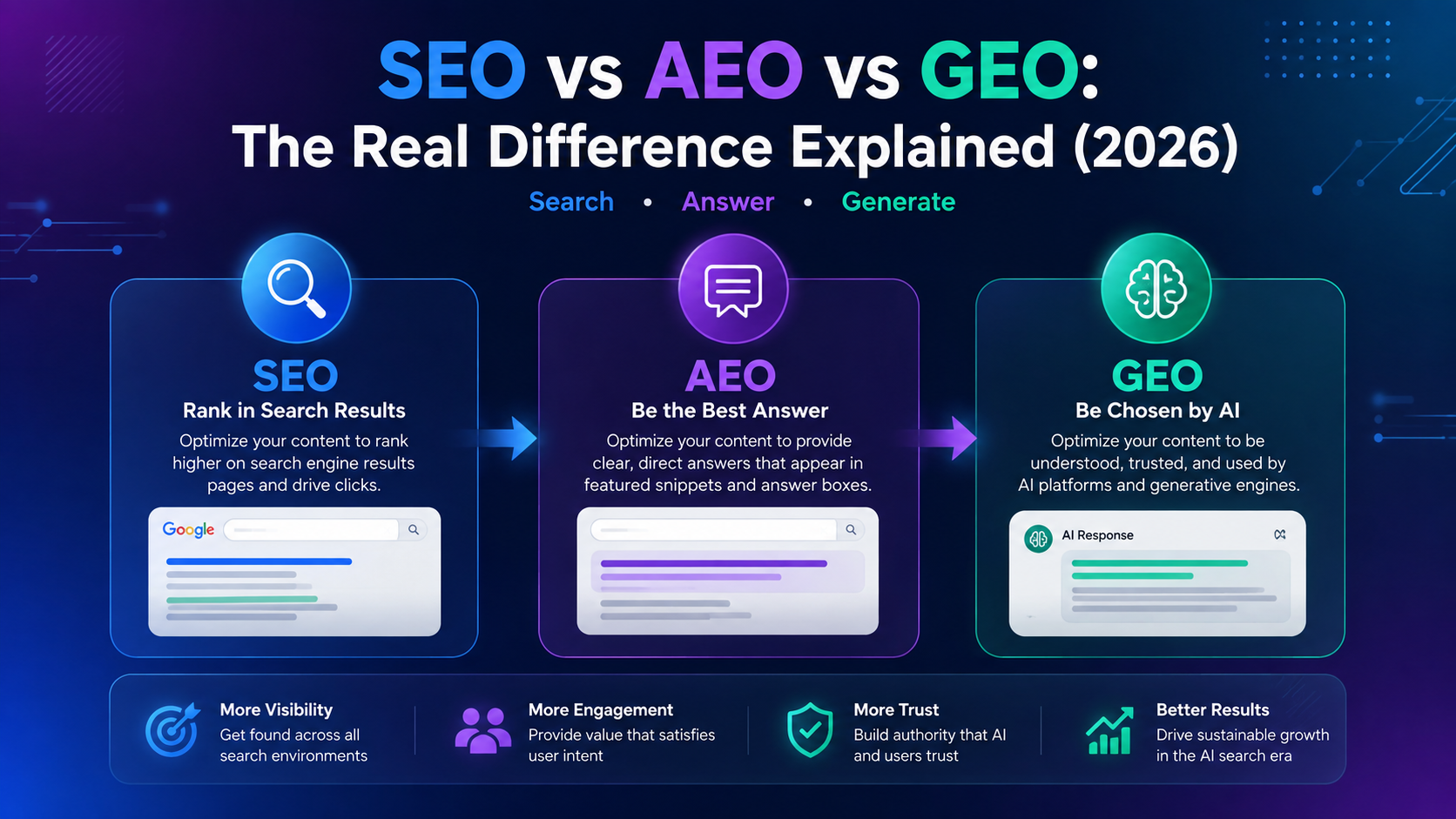
SEO optimizes for discoverability. It is concerned with whether your content shows up at all when someone searches. AEO optimizes for answer clarity. It is concerned with whether your content can resolve a specific question directly. GEO optimizes for machine comprehension. It is concerned with whether an AI system can accurately parse, contextualize, and potentially reference what you wrote.
These are not sequential steps you complete one after another. They operate simultaneously on the same piece of content. A single well-written paragraph can satisfy all three at once: it can use language a search engine associates with a relevant query, phrase the key point as a direct extractable answer, and use precise, unambiguous terminology that a generative system can parse without confusion.
The mistake to avoid is oversimplifying this into “SEO is for Google, AEO is for voice search, and GEO is for AI.” That framing was already outdated the moment Google folded AI Overviews directly into its main results page. Search environments are converging, not splitting into neat, separate lanes.
Comparison Table: SEO vs AEO vs GEO
| Dimension | SEO | AEO | GEO |
|---|---|---|---|
| Primary goal | Improve discoverability in search results. | Provide direct, extractable answers to specific questions. | Help generative AI systems understand and evaluate content. |
| Main environment | Search engine results pages | Featured Snippets, People Also Ask, Voice Assistants, AI Overviews | Chatbots, AI search assistants, generative summaries |
| Typical user behavior | Browsing ranked results, comparing options | Seeking a quick, specific answer | Asking conversational questions, expecting synthesized responses |
| Content focus | Relevance, authority, technical structure | Clarity, directness, self-contained explanations | Precision, consistent terminology, explicit context |
| Optimization methods | Keyword research, backlinks, page speed, technical SEO | Clear definitions, question-based headings, concise answers | Structured sections, entity clarity, original explanations |
| Success signals | Rankings, organic traffic, click-through rate | Snippet appearances, PAA inclusion, answer visibility | Being referenced or considered by AI systems, though this is not directly measurable |
| Example platforms | Google, Bing | Google Featured Snippets, Alexa, Google AI Overviews | ChatGPT, Gemini, Perplexity, AI Overviews |
Notice that Google AI Overviews appears in both the AEO and GEO rows. That overlap is intentional. It reflects how AI Overviews function as a hybrid: they surface direct answers like a traditional answer engine, but they generate those answers using retrieval and synthesis techniques closer to a generative system.
How SEO, AEO, and GEO Work Together
Think of SEO as the layer that gets your content into the room. AEO is what makes it useful the moment someone glances at it. GEO is what makes it legible to a machine trying to summarize the room’s contents for someone who never walked in.
A page that ranks well but buries its answer under three paragraphs of introduction satisfies SEO while failing AEO. A page with a perfectly extractable answer but weak topical authority and no supporting depth might get pulled into a snippet once, then quietly disappear as competing pages with stronger overall relevance take its place. A page that is technically well optimized and clearly answers questions but uses inconsistent terminology and vague, unexplained claims gives a generative system little reason to treat it as a reliable source to draw from.
Before optimizing for any of these environments, understanding search intent helps determine what type of answer the user actually needs in the first place. Getting that wrong makes every downstream optimization effort weaker, regardless of how well it is executed technically.
Does GEO Replace SEO?
No, and this is worth stating plainly because a fair amount of content circulating right now implies otherwise. GEO does not replace SEO for a simple reason: most content discovery still happens through traditional search, and generative AI systems themselves rely on indexed, crawlable, well-structured web content to form their responses. If your site has poor technical SEO, weak authority, or thin content, GEO tactics will not compensate for that. Generative systems still draw heavily on the same signals of relevance and trustworthiness that have always mattered for search visibility.
GEO is better understood as an additional layer built on top of solid SEO, not a substitute for it. Businesses that abandon SEO fundamentals to chase AI visibility are optimizing for a smaller, less certain channel while weakening the larger one that still drives the bulk of organic traffic.
How Google AI Overviews Are Changing Search
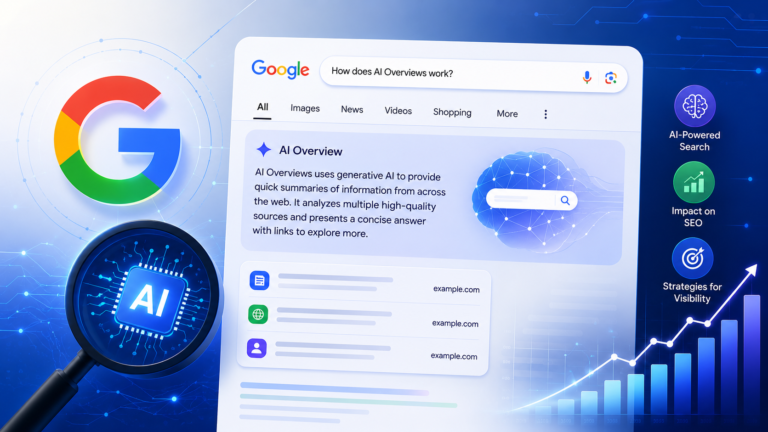
The growth of Google AI Overviews has changed how a meaningful share of users discover information, since some queries now surface a synthesized summary above traditional results. For certain informational queries, users get an answer without clicking through to any individual page, which reduces click volume for content that previously would have captured that traffic through a standard ranking.
This does not mean traditional ranking has become irrelevant. It means visibility now needs to be measured beyond click-through rate alone. Being referenced as a source within an AI overview, even without a click, can still contribute to brand visibility and trust. The practical response is not to abandon ranking efforts but to focus more deliberately on being a genuinely useful source: content with clear, extractable answers, original information that is not simply a rewrite of five other articles on the same topic, and demonstrated authority on the subject. Google has not published a precise formula for how sources get selected for AI Overviews, and any claim describing an exact mechanism should be treated with skepticism.
How ChatGPT, Gemini, and Perplexity Change Content Discovery
Conversational AI assistants introduce a discovery path that does not depend on a search results page at all. A user asks a direct question, and the system generates a synthesized answer, sometimes with citations, sometimes without.
This shifts part of content discovery away from ranking-based visibility toward being the kind of source a retrieval system finds clear enough to use accurately. Perplexity, for instance, tends to cite sources directly within its responses, while ChatGPT’s citation behavior depends on whether it is using browsing or retrieval features for a given query. None of these systems guarantee inclusion for any piece of content, and their retrieval methods continue to evolve. What content creators can influence is clarity, structure, and accuracy, the same qualities that have always separated genuinely useful content from filler.
A Practical SEO + AEO + GEO Content Framework
Step 1: Understand Search Intent
Before writing anything, determine whether the person searching wants a quick answer, a comparison, a tutorial, or a deep explanation. This shapes format decisions for all three practices at once.
Step 2: Create Useful and Original Content
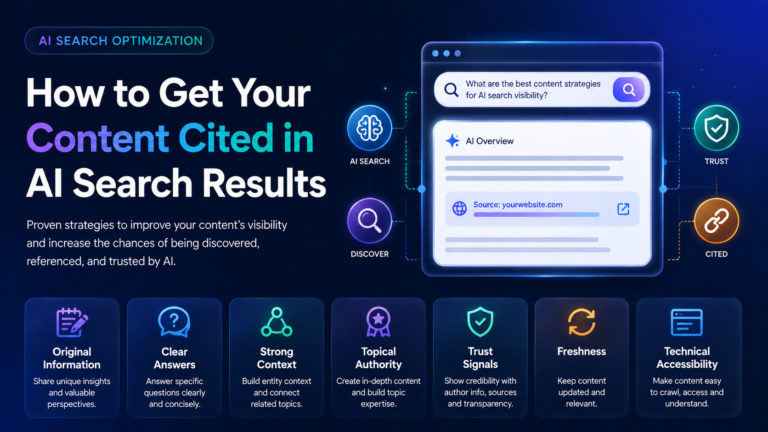
Original insight, drawn from real reasoning rather than a rewrite of existing top-ranking pages, is what separates content that earns trust from content that merely occupies space.
Step 3: Answer Important Questions Clearly
State the direct answer early, in plain language, before expanding into supporting detail. This single habit does more for AEO than any other tactic.
Step 4: Build Topical Authority
Cover a subject thoroughly across multiple related pieces rather than treating each article as an isolated unit. Search engines and AI systems both weigh consistent depth on a topic.
Step 5: Strengthen Entity and Contextual Signals
Name specific tools, concepts, and terms consistently throughout a piece rather than switching between synonyms. This reduces ambiguity for both search algorithms and generative systems trying to parse relationships between ideas.
Step 6: Add Relevant Internal Links
Link to related content where it genuinely extends the reader’s understanding. This also helps search engines and AI crawlers understand how your content connects across a site.
Step 7: Keep Important Content Fresh
Outdated statistics, deprecated tools, or old platform behavior undermine trust quickly, particularly for AI systems that weigh recency when synthesizing an answer.
Step 8: Measure Visibility Across Search and AI Platforms
Track rankings and organic traffic as before, but also monitor whether your brand or content appears in AI-generated answers when you manually test relevant queries. This will not produce clean analytics data, but it offers a directional read on visibility beyond clicks.
Practical example: Consider a business publishing an article on “how to reduce cart abandonment.” For SEO, the piece targets that core phrase and related variations, with clean headings and fast-loading pages. For AEO, it opens with a direct two-sentence answer defining cart abandonment and its typical causes, then uses question-based subheadings like “why do customers abandon carts” and “what reduces abandonment fastest.” For GEO, it uses consistent terminology throughout (never switching between “cart abandonment” and “checkout drop-off” without explanation), explains cause and effect clearly (“abandonment often rises when shipping costs appear late in checkout, because it breaks the price expectation set earlier”), and includes specific, concrete examples rather than vague generalities. Each element serves a distinct purpose, but none of them conflict with the others.
Common SEO, AEO and GEO Mistakes
Treating AEO as a separate content type instead of a writing habit applied across all content is one of the most common errors. So is assuming GEO requires an entirely new content format when in practice it mostly requires more precision in language that should have been there anyway. Another frequent mistake is neglecting technical SEO because AI search feels more urgent, which weakens the foundation both AEO and GEO depend on. Vague, hedge-filled writing that never commits to a clear claim also hurts across all three practices, since neither search engines nor AI systems can extract a confident answer from a sentence that qualifies itself into meaninglessness.
Which One Should You Focus On?
If forced to prioritize, SEO fundamentals still deserve the most consistent investment, because they remain the foundation everything else builds on. AEO should be treated as a writing standard applied to every piece of content, not a separate initiative. GEO deserves attention, particularly for informational content likely to be referenced in AI-generated answers, but it should be layered on top of strong SEO and AEO practices rather than pursued as a replacement for them.
SEO vs AEO vs GEO Checklist
-
Content targets a clearly understood search intent, confirmed by reviewing the actual SERP.
-
The core answer appears within the first few sentences of relevant sections.
-
Key terms are used consistently throughout the piece.
-
Claims include enough context to be understood without external assumptions.
-
The article covers the topic with genuine depth, not just surface-level definitions.
-
Internal links connect to genuinely related content.
-
Statistics, tools, and examples reflect current information.
-
Headings reflect real questions a reader would ask, not keyword stuffing.
-
The piece would still make sense if a single paragraph were extracted and read alone.
Conclusion
The debate over SEO vs AEO vs GEO has produced a lot of noise because writers keep framing them as competitors. They are not. SEO gets your content into the conversation. AEO makes sure it answers the question clearly once it’s there. GEO improves the odds that an AI system understands and can responsibly draw on what you wrote. None of them replace the others, and no honest strategy in 2026 treats them as interchangeable. The businesses that come out ahead will be the ones building genuinely useful, clearly structured content once, and letting it work across all three environments at the same time.