Imagine you want to understand why your laptop’s battery drains faster in cold weather. You could type that question into Google and scan a page of blue links, or you could ask an AI search tool and read a written explanation with a few sources listed below it. Both get you an answer, but the path to that answer looks very different.
People now have more than one way to look things up online. Traditional search typically returns a list of ranked results for you to click through. AI-powered search experiences, by contrast, tend to generate a synthesized response directly on the page and then point to the sources behind it. Neither approach has fully replaced the other, and understanding how they differ helps you pick the right tool for the task in front of you.
Direct Answer: What Is the Difference Between AI Search and Google Search?
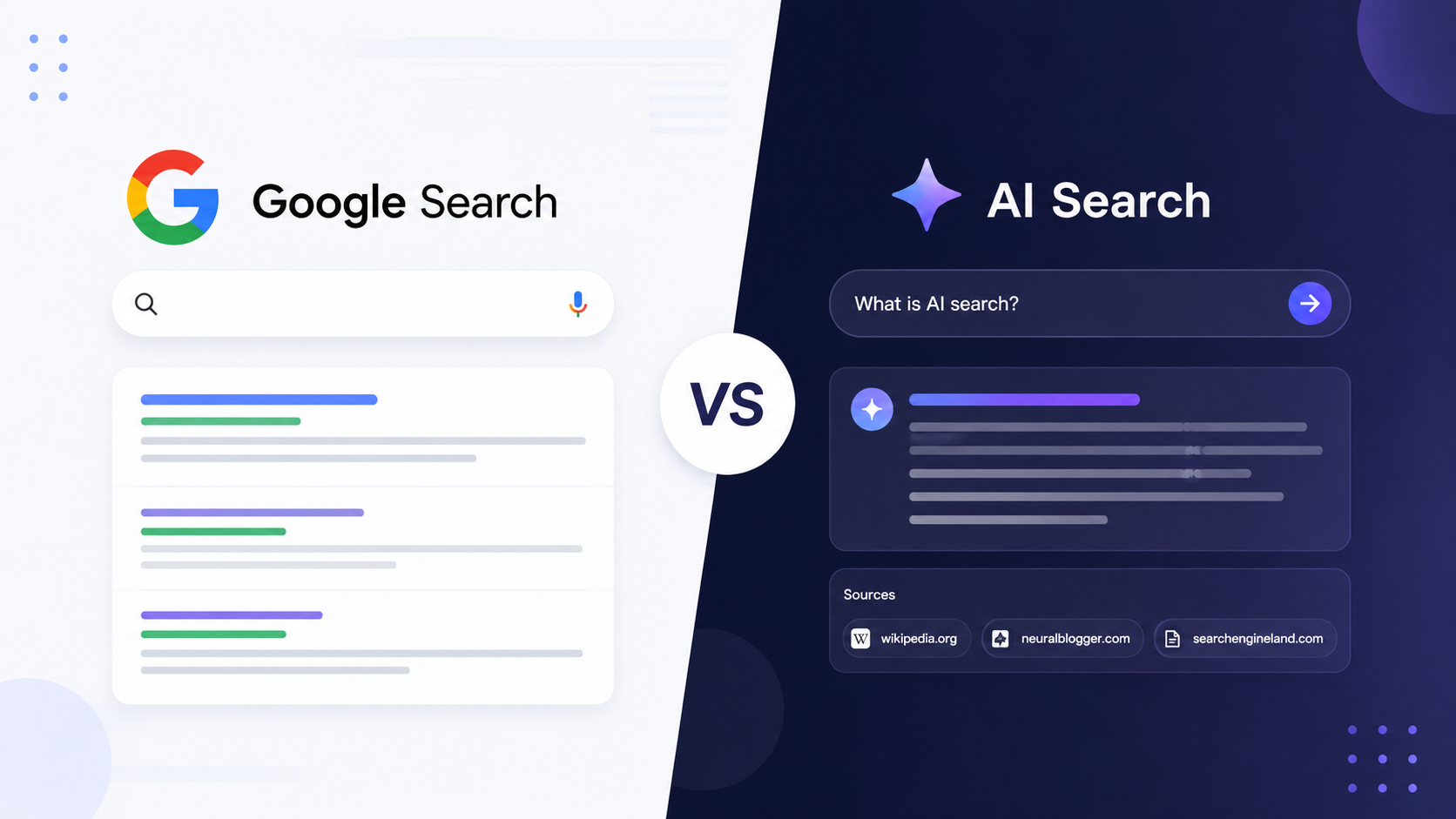
The core difference in the AI search vs Google search comparison is how information is delivered. Google Search returns a ranked list of links for you to evaluate and click through yourself. AI search generates a written answer by synthesizing information from multiple sources, often with citations attached. Google is result-oriented; AI search is answer-oriented. Neither is universally better, since the right choice depends on what you’re trying to accomplish.
Key Takeaways
- AI search generates synthesized written answers, while traditional Google Search returns a ranked list of links.
- AI search supports natural, conversational, multi-turn questions; Google Search is typically single-query based, though newer AI-powered modes are narrowing that gap.
- Google Search still gives users direct, unfiltered access to many original webpages to compare themselves.
- AI search often reduces the need to click through to a website for simple questions, a pattern known as zero-click search.
- Source presentation differs: AI search tends to show a shorter list of cited sources, while Google Search shows many organic results side by side.
- Neither approach replaces the other. Many people now move between both depending on the task.
- Website visibility now depends on being discoverable and understandable to both traditional crawlers and AI systems that generate summarized answers.
What Is AI Search?
AI search refers to tools and features that let users ask questions in natural language and receive a generated answer rather than a plain list of links. Instead of typing short keyword phrases, users can ask full questions the way they might ask a person, and the system responds with a written explanation.
A few characteristics are common across most AI search tools, though implementation varies by platform:
- Natural-language queries. You can phrase a question conversationally instead of guessing keyword combinations.
- Synthesized responses. The tool pulls information from multiple sources and combines it into a single, readable answer rather than presenting separate results.
- Follow-up questions. Many AI search experiences retain context, so you can refine or extend your original question without starting over.
- Conversational interaction. The exchange can feel more like a dialogue than a single lookup.
- Citations or source links. Where available, AI search tools attach references so users can trace the information back to its origin, though the depth and consistency of citations vary by platform.
It is worth noting that AI search platforms do not all behave the same way. Some rely heavily on live web data, others draw more on pretrained knowledge, and citation practices differ from one tool to the next. Anyone comparing options should look at the best AI search engines currently available rather than assuming one experience represents all of them.
What Is Traditional Google Search?
Traditional Google Search is the search experience most people have used for years: you type a query, and Google returns a search engine results page, commonly called a SERP, containing a mix of organic listings, advertisements, and specialized features.
Key elements of this experience include:
- Search queries. Usually shorter, keyword-based phrases, though Google has become better at interpreting longer natural-language input over time.
- Organic results. Web pages ranked according to Google’s assessment of relevance, quality, and authority.
- Advertisements. Paid listings that appear alongside or above organic results for many commercial queries.
- Featured snippets and other search features. Elements like knowledge panels, local packs, and image carousels that answer certain queries directly on the page.
- Links to webpages. Every organic result points to a full page the user can visit.
- User evaluation. The user decides which result looks most trustworthy or relevant and chooses where to click.
This structure gives users direct control over which sources they consult and lets them compare multiple perspectives on the same page before deciding where to go.
AI Search vs Google Search: Key Differences
| Feature | AI Search | Traditional Google Search |
|---|---|---|
| Answer format | A synthesized written response generated from multiple sources | A ranked list of links to individual webpages |
| User interaction | Conversational, question and answer style | Query and result, typically one search at a time |
| Follow-up questions | Often supported with retained context | Requires a new search or refined query |
| Source discovery | A shorter set of cited sources tied to the generated answer | Many organic results displayed for the user to browse |
| Links | Citations pointing to select sources | Direct links to a broad range of webpages |
| Search behavior | Encourages longer, exploratory questions | Encourages shorter, targeted queries |
| Research workflow | Good for quick synthesis and orientation | Good for comparing multiple viewpoints directly |
| User control | The user reviews a generated summary, then chooses whether to dig deeper. | The user chooses which result to open from the start |
| Best use cases | Explaining concepts, comparing ideas, exploratory questions | Finding specific websites, comparing many sources, and local and current information |
These differences are general patterns rather than fixed rules, since platforms continue to update how they present answers and sources.
How AI Search Changes the Search Experience
Conversational search changes the rhythm of looking something up. Instead of typing a short phrase and scanning results, users often ask a complete question the way they would ask a knowledgeable friend.
This shift shows up in a few practical ways:
- Asking complete questions. People phrase queries as full sentences rather than fragments.
- Refining through follow-ups. A user can ask a broad question first, then narrow it with a second or third question without repeating context.
- Receiving summarized information. Instead of ten separate results, the user gets one consolidated explanation.
- Exploring related concepts. AI search often surfaces adjacent ideas the user did not explicitly ask about, which can be useful for learning.
- Moving toward conversational exploration. The interaction can resemble a back-and-forth discussion rather than a single transaction.
None of this means users no longer need search results. Many questions still benefit from seeing several original sources side by side, particularly when the topic is contested, technical, or time-sensitive.
How Google Search Helps Users Find Information
Traditional search remains strong precisely because it gives users unfiltered access to the wider web. Several use cases still favor this approach:
- Direct access to webpages. Users can go straight to a specific site rather than reading a summary about it.
- Comparing multiple sources. A results page lets you open several links in new tabs and judge them side by side.
- Finding specific websites. Navigational searches, like looking for a company’s official site or login page, are handled efficiently by traditional search.
- Local search. Maps, business listings, and location-based results are a core strength of Google Search.
- Product search. Shopping results, price comparisons, and retailer listings benefit from a visual, browsable layout.
- News and current information. Fresh, fast-moving stories are often better served by a live results page than a generated summary.
- Search filters and specialized results. Tools like date filters, image search, and video search give users precise control that a single generated answer cannot easily replicate.
These strengths are why Google Search continues to be the starting point for a large share of everyday queries, even as AI-powered features become more common.
AI Search vs Google Search for Different Use Cases
| Use Case | AI Search | Google Search | Better Starting Point |
|---|---|---|---|
| Learning a new concept | Strong, gives a structured explanation | Requires reading multiple pages to piece together | AI search |
| Researching a complex topic | Good for orientation and framing | Better for depth and multiple perspectives | Often both, starting with AI search |
| Finding a specific website | Limited, not designed for navigation | Strong, direct link to the site | Google Search |
| Finding local businesses | Limited compared to dedicated local features | Strong, with maps and listings | Google Search |
| Comparing multiple sources | Limited, summarizing rather than displaying all options | Strong results shown side by side | Google Search |
| Finding recent news | Depends on how current the platform’s data is | Strong for real-time updates | Google Search |
| Shopping research | Useful for narrowing down options conversationally | Strong for browsing listings and prices | Often both |
| Troubleshooting a technical issue | Useful for step-by-step guidance | Useful for finding forum threads and documentation | Often both |
| Exploring a broad topic | Strong for a quick overview | Strong for finding depth once a direction is chosen | AI search to start, Google Search to go deeper |
The pattern here is consistent: AI search tends to work well for orientation and explanation, while Google Search tends to work well for comparison, navigation, and current or local information. The right starting point depends on the goal, not on which tool is newer.
Which Provides Better Sources and Citations?
This is one of the more misunderstood parts of the comparison. It helps to separate a few distinct concepts.
Links in search results are direct pointers to full webpages. When you see an organic result on Google, you are looking at a page that Google’s systems have indexed and ranked, and clicking it takes you to the complete, unedited source.
AI-generated citations work differently. When an AI search tool answers a question, it may attach references to the sources it drew from while composing the answer. These citations tell you where specific information came from, but the surrounding response is the AI system’s own synthesis rather than a direct quote from any single source.
Google’s own search experience has increasingly blended both approaches. Features like Google AI Overviews generate a summarized answer directly on the results page while still linking out to the pages that informed it, sitting somewhere between a traditional result list and a fully conversational AI answer.
It is important not to assume that AI-generated citations are automatically more reliable than a traditional list of links. A citation confirms that a source exists and contributed to the answer, but it does not guarantee the summary faithfully represents that source’s full context or nuance. Users should still click through to original sources when a claim matters, particularly for medical, legal, financial, or safety-related information.
AI Search vs Google Search for Research
Research is rarely a single step, and both search types tend to play different roles across a typical workflow.
- Initial discovery. AI search can quickly orient you to a topic you know little about, framing the key ideas in plain language.
- Understanding a topic. A synthesized explanation can clarify terminology and context faster than reading several separate pages.
- Finding primary sources. Traditional search remains useful for locating original studies, official documentation, or firsthand accounts.
- Comparing sources. Viewing several results side by side on a Google results page makes it easier to spot disagreement between sources.
- Following references. Citations from an AI-generated answer can point you toward specific pages worth reading in full.
- Verifying information. Any factual claim that matters, whether from an AI summary or a search snippet, should be checked against a reliable, original source before it is trusted or repeated.
A practical approach is to treat AI-generated answers as a useful starting map rather than a final destination, especially for anything where accuracy has real consequences.
AI Search and Zero-Click Searches
A zero-click search happens when a user gets enough information directly within the search experience and never visits an external website. This has existed in some form for years through featured snippets and knowledge panels, but AI-generated summaries have made it more common for a wider range of queries.
This does not mean AI search always produces a zero-click outcome. Many questions still require the user to click through, particularly when they want more detail, need to verify a claim, or are comparing options. But when a query has a short, factual answer, an AI-generated response can satisfy the user without a click.
This pattern matters to website owners because it changes what counts as a successful search outcome. A page can be read and used by an AI system to generate an answer without ever receiving a visit, which is part of why visibility inside AI-generated responses has become a topic of its own.
What Does AI Search Mean for SEO?
SEO remains relevant because websites still need to be discoverable, accessible, useful, and understandable, whether the audience is a human scanning a results page or an AI system generating a summary. The underlying goal has not changed: create content that reliably answers real questions and is easy for systems to interpret and trust.
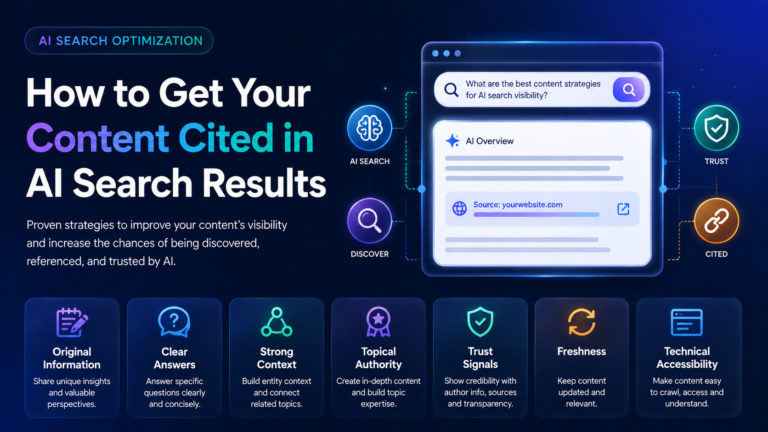
What has changed is that visibility now depends on more than ranking position alone. A page can rank well and still be underrepresented in an AI-generated answer if it is not the clearest or most direct explanation of the topic available. This is part of why practices grouped under AI search optimization have grown alongside traditional SEO rather than replacing it.
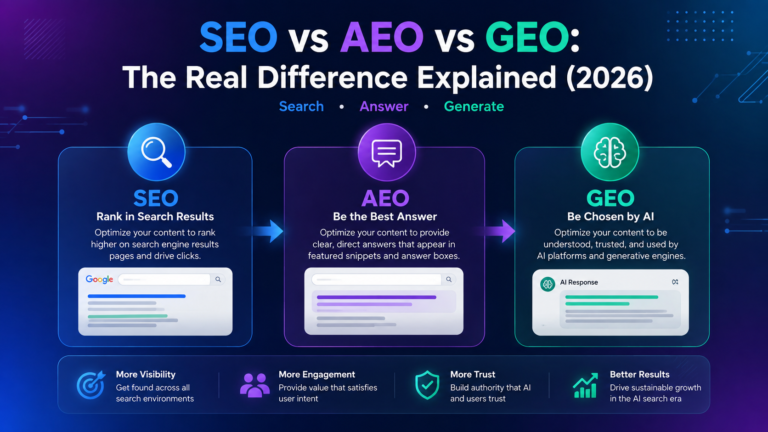
It also helps to understand how these disciplines relate to one another conceptually. Comparing approaches like SEO vs AEO vs GEO clarifies that traditional search engine optimization, answer engine optimization, and generative engine optimization address overlapping but distinct goals, rather than being separate replacements for one another.
Can AI Search and Google Search Work Together?
In practice, most people already move between both without thinking of it as a deliberate strategy. Making that workflow intentional can make research faster and more reliable.
- Use AI search to explore an unfamiliar topic and get oriented quickly.
- Identify the specific sources, terms, or concepts mentioned in the response that seem worth exploring further.
- Open the original webpages behind those sources rather than relying only on the summary.
- Switch to Google Search when you need a specific website, local results, current news, or a broader set of results to compare yourself.
- Verify anything important, especially factual claims or figures, against an authoritative, original source before treating it as settled.
This workflow treats AI search as a starting point for understanding and Google Search as a tool for verification, comparison, and direct access. Used this way, the two approaches complement each other rather than competing.
Common Misconceptions About AI Search and Google Search
“AI search completely replaces Google.” In practice, AI search and Google Search often serve different steps of the same task, and traditional search remains essential for navigation, comparison, and local results.
“Google Search is no longer useful.” Google Search continues to handle a huge range of queries effectively, particularly ones involving specific websites, current events, and local information.
“AI answers are always accurate.” AI-generated summaries can misrepresent nuance, cite outdated information, or make small errors, especially on complex or fast-changing topics. Important claims still deserve verification.
“AI search always provides better sources.” A citation is not automatically more trustworthy than an organic search result. Both require the user to judge the underlying source.
“Traditional search cannot handle natural-language questions.” Google Search has become considerably better at interpreting longer, conversational queries over time, even though its results still take the form of a link list rather than a generated answer.
“AI search eliminates the need to visit websites.” Some queries do end in a zero-click outcome, but many others still benefit from visiting the original page for full context, detail, or verification.
The Future of Search
Search is likely to keep combining elements of both approaches rather than settling on one model. Traditional result lists, AI-generated summaries, and conversational interfaces already coexist on the same results page for many queries. Source links continue to matter as a way for users to verify and explore further.
Other developments worth watching include multimodal search, where users can search using images, voice, or a combination of inputs alongside text, and more personalized search experiences that adjust results based on context and prior activity. How far these trends go, and how quickly they are adopted, remains to be seen, so it is worth treating any specific prediction with some caution.
Final Verdict: AI Search vs Google Search
Weighing AI search vs Google search does not produce a single winner, because the two are built for different moments in the process of finding information. AI search can be particularly useful for conversational exploration, quick synthesis of a new topic, and working through follow-up questions without starting over. Traditional Google Search remains essential when users want direct access to specific websites, need to compare multiple sources themselves, are looking for local information, or want current results they can evaluate firsthand.
The strongest approach for most people is not choosing one over the other but knowing which one fits the task in front of them and being willing to switch between AI search and Google Search as that task evolves.

Nikunj Pandya
Nikunj Pandya is an AI and technology professional with over 5 years of experience exploring how emerging technologies can solve real-world problems. He focuses on Artificial Intelligence, AI Search, and AI tools, sharing practical insights to help readers understand and make better use of new technology.