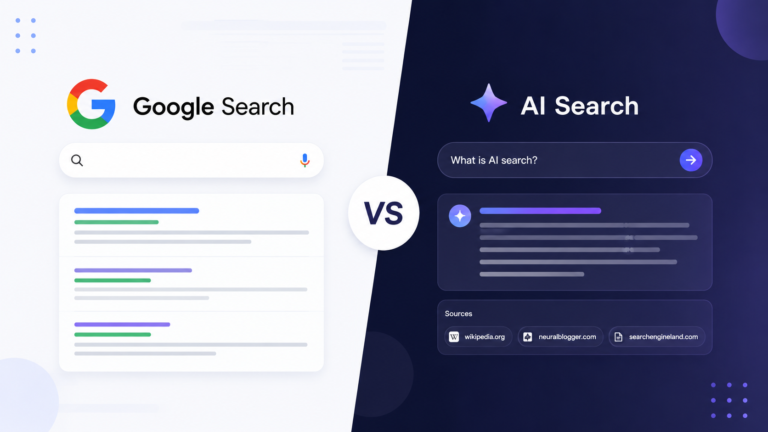
Search has quietly split into two experiences. One still shows ten blue links. The other generates an answer, pulls together a handful of sources, and sometimes never sends the user anywhere at all. Publishers who spent a decade mastering the first experience are now asking the same question in different words: how do you get picked up in the second one?
There is no lever that flips this on. AI search optimization is less about a technical trick and more about making content easy to find, easy to parse, and easy to trust so that a retrieval system has a reason to pull it into an answer. This guide breaks down how that actually works, platform by platform, without pretending there is a guaranteed formula.
Direct Answer
You improve your chances of being cited in AI search results by publishing original, clearly answered content, structuring it so key information is easy to extract, building genuine topical authority around the subject, and maintaining accurate, up-to-date information on a technically accessible site. None of this guarantees a citation on any specific platform.
Key Takeaways
-
AI search visibility depends on discovery, understanding, and trust working together, not any single tactic.
-
Being cited, mentioned, retrieved, or used as background information are different outcomes, and platforms handle them differently.
-
Original analysis and firsthand explanation are harder for AI systems to treat as redundant than rewritten summaries.
-
Clear, self-contained answers are easier for retrieval systems to lift and use accurately.
-
Topical authority, built through connected content rather than isolated posts, tends to matter more than any single optimized page.
-
Technical accessibility, like crawlability and clean structure, is a prerequisite, not an advantage.
-
AI search optimization should support existing SEO work, not replace it.
What Does It Mean to Be Cited in AI Search?
“Getting cited” is often used loosely, and that looseness causes confusion. In practice, there are several distinct outcomes:
-
Being linked as a source. The AI response includes a visible link to your page, similar to a citation in a traditional search result.
-
Being mentioned by name. Your brand, product, or publication is named in the answer without necessarily linking back.
-
Being used as supporting information. Your content shapes the answer’s wording or facts, but you receive no visible attribution at all.
-
Being retrieved but not shown. A system pulls your page into its retrieval step while researching a query, then the response ends up favoring other sources.
-
Appearing in a traditional search result. Your page ranks normally, separate from any AI-generated summary on the same page.
These are not interchangeable, and different AI products handle them differently. Google AI Overviews typically shows inline links attached to specific claims. Perplexity often displays a numbered source list alongside its answer. ChatGPT’s citation behavior depends heavily on whether browsing or search grounding is active for that particular response, and it does not always attribute information the same way. Treating all of these as one phenomenon leads to strategies that fit no platform well.
How AI Search Systems Find and Reference Content
The exact retrieval and ranking mechanics of any AI search product are proprietary, and no outside guide can describe them precisely. What can be said with reasonable confidence is that these systems often depend on some mix of:
-
Existing search indexes and crawled web content
-
Retrieved documents matched against the user’s query
-
Structured information, such as clear headings, schema, and defined entities
-
Context matching between the query’s intent and a page’s content
-
Signals related to trust, accuracy, and consistency across sources
The exact systems vary by platform, and each one can change its approach without public notice. A page that depends on being crawlable and indexable, that answers a specific question clearly, and that fits naturally into the topic it covers, gives itself the best available odds. Nothing beyond that can be claimed responsibly.
Why Some Websites Get Mentioned More Often
Sites that show up repeatedly across AI-generated answers tend to share a pattern rather than a trick. They cover a subject in depth instead of once. They state information plainly instead of burying it in a preamble. They keep facts current. And they are the kind of source a system can quote without much risk of being wrong, because the claims are specific, attributable, and consistent with how the rest of the internet describes the same topic.
None of that is exotic. It is closer to what strong SEO and editorial standards already demand. AI search optimization amplifies the value of doing those things well, rather than introducing a separate discipline.
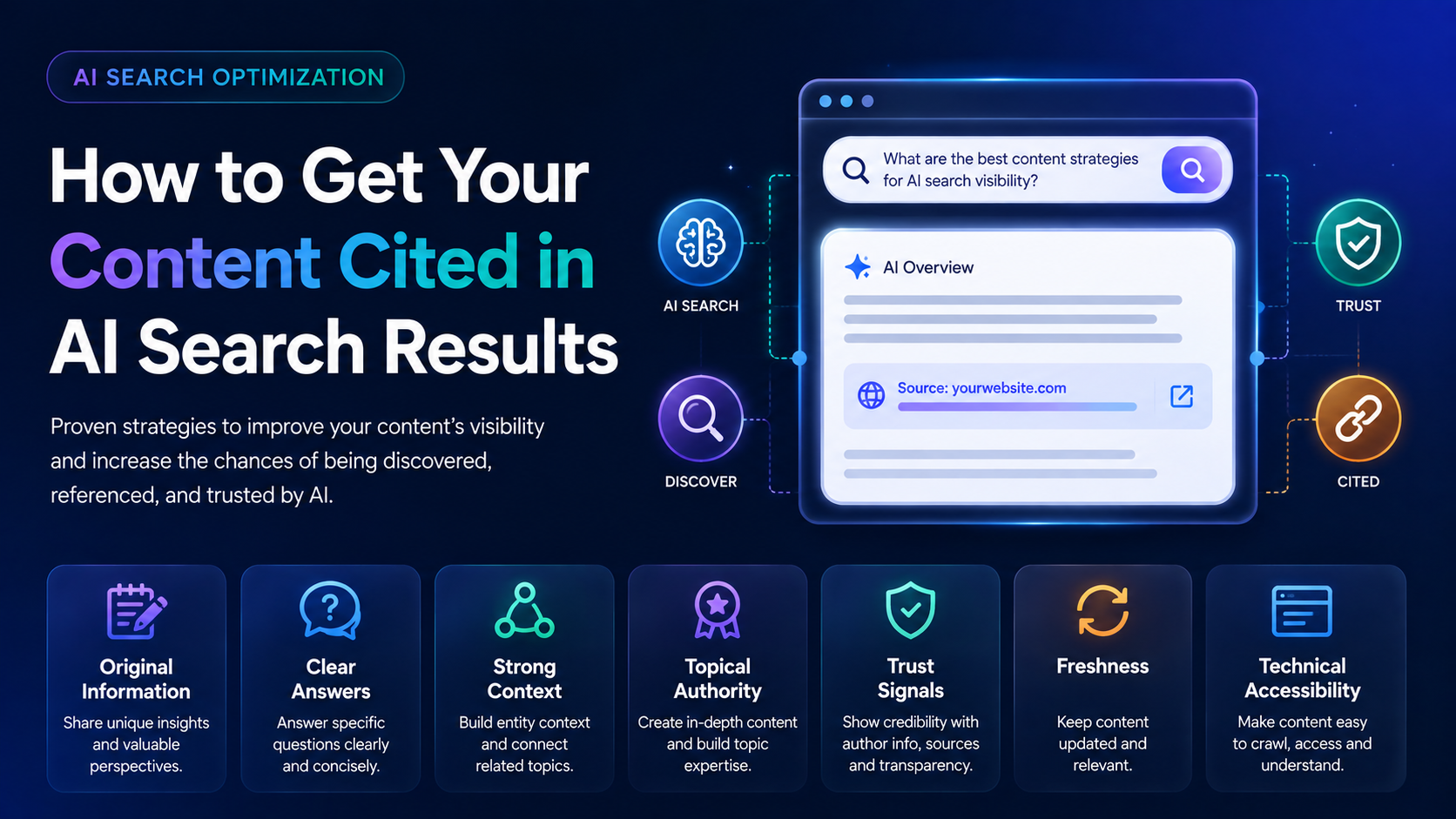
The AI Search Optimization Framework
The relationship between these factors can be thought of as a chain:
Original information → Clear answers → Strong context → Topical authority → Trust signals → Freshness → Technical accessibility
Each stage depends on the one before it. Original information with no clarity is hard to extract. Clear answers with no context are easy to misread. Strong context without topical authority looks like an isolated claim. Authority without trust signals is unverifiable. Trust without freshness ages badly. And all of it is worthless if a system cannot technically access the page.
1. Create Original Information
Content that repeats what dozens of other pages already say has limited value to a retrieval system, because the system already has that information from other sources. The differentiator is originality, and originality does not require inventing experience you do not have. It can come from:
-
Genuine firsthand experience, only when it actually exists
-
Original research or data you collected yourself
-
A unique analytical angle on a known topic
-
A practical framework readers can apply directly
-
Expert commentary that explains reasoning, not just conclusions
-
Original, specific examples rather than generic placeholders
-
Updated information that corrects or extends outdated common knowledge
-
Comparisons built on stated, real criteria rather than vague impressions
A page that adds one of these is doing something a summarization system cannot easily replicate by pulling from ten other pages that say the same thing.
2. Answer Specific Questions Clearly
Clarity is not about writing shorter sentences. It is about structuring content so the answer is where a reader, or a retrieval system, expects to find it. That means:
-
Stating a direct answer before elaborating
-
Defining terms precisely, not implicitly
-
Using question-based subheadings where they mirror actual searches
-
Following a short answer with a deeper explanation, rather than the reverse
-
Using comparison tables for anything involving multiple options
-
Breaking processes into numbered steps
-
Including specific examples rather than abstractions
This benefits human readers first. It also happens to make the content easier for a system to extract cleanly, because there is less ambiguity about what the actual answer is.
3. Build Strong Topic and Entity Context
Entity context means making relationships explicit instead of assuming they are understood. Consider a product page. Rather than repeating the product name, a page with strong context makes clear that this product belongs to a category, solves a specific problem, serves a specific type of user, and connects to related concepts a reader might already know.
For example, a page about a scheduling tool should not just say “the tool schedules appointments.” It should establish that it belongs to the appointment scheduling software category, that it solves the specific problem of double bookings for service businesses, that it serves solo practitioners and small teams rather than enterprise operations, and that it relates to concepts like calendar syncing and automated reminders. That kind of explicit framing matters more than repeating the product name across the page.
4. Demonstrate Real Topical Authority
One well-written article rarely establishes authority. A connected cluster does. A useful structure looks like a pillar article covering a broad topic, supported by narrower articles that each go deeper into one part of it, all linked to each other with context, and all updated as the subject evolves.
A practical example: a pillar page on AI search could be supported by separate articles on search intent, on Google AI Overviews, on AI content optimization, and on measuring AI referral traffic. Each supporting piece strengthens the pillar, and the pillar gives each piece somewhere to point back to. That structure signals depth in a way that a single isolated post cannot.
5. Add Trust and Credibility Signals
Trust signals help both readers and systems evaluate whether information is reliable. Useful signals include clear author information, accurate and verifiable claims, sourcing where it is genuinely relevant, transparent language about what is known versus assumed, original work rather than recycled summaries, regular updates, and visible ownership of the site’s purpose.
None of this works in isolation. Adding an author bio does not create authority by itself. It only matters alongside content that actually reflects the expertise the bio claims.
6. Keep Important Information Fresh
Freshness matters when the underlying facts change: statistics, platform features, search behavior, examples, recommendations, and technical instructions all shift over time. It does not matter when the publish date is edited without any real update to the content. Systems and readers alike can tell the difference between a page that reflects current reality and one that has simply been republished.
7. Make Content Easy to Crawl and Access
The basics still apply. Pages need to be crawlable, use clear HTML structure, carry useful headings, load quickly, avoid unnecessary content blockers, and have accurate canonical tags so systems index the right version of a page. None of this is glamorous, and none of it substitutes for good content, but a page that fails at this level is invisible regardless of how well it is written.
8. Structure Content for Easy Retrieval
Clear sections, descriptive headings, focused paragraphs, tables, lists, and explicit definitions all make a page easier to parse. Contextual internal links help too, by showing how one piece of content relates to another. Formatting alone will not earn a citation, but poor formatting can prevent a genuinely useful page from being extracted cleanly.
9. Build Relevant Internal Connections
Internal links should connect ideas a reader would actually want to explore next. If an article on AI search optimization discusses SERP research, a natural link point is a resource on SEO Chrome extensions used for that kind of analysis. These links help both readers and systems understand how a site’s content fits together as a coherent body of knowledge, rather than a collection of disconnected pages.
10. Earn External Recognition and References
Mentions, links, and citations from other credible sites remain a meaningful trust signal. A page that other publishers, forums, and communities reference on its own merit is behaving like something worth citing, which is a stronger signal than any on-page optimization.
How to Optimize Content for Google AI Overviews
Google has not published a separate ranking system exclusively for AI overviews. What improves a page’s overall usefulness in Google Search tends to also improve its odds of contributing to an AI-generated summary. That includes giving clear, direct answers early, delivering genuine original value instead of a rewritten summary, aligning tightly with the actual search intent behind a query, providing helpful surrounding context rather than an isolated fact, demonstrating trustworthy sourcing and accuracy, and covering a topic with real depth instead of a shallow overview.
There is no confirmed, separate optimization method that guarantees inclusion in AI Overviews. Google has stated that pages eligible for standard search results are the same pool eligible for AI features, which reinforces that strong fundamentals matter more than platform-specific tricks.
How to Improve Visibility in AI Assistants and Generative Search
ChatGPT, Gemini, and Perplexity are not interchangeable systems, and treating them as one audience is a common mistake. They can differ in how they select sources, whether they browse the live web or rely on a fixed index, whether they operate through search partnerships with other providers, how they display or withhold citations, how fresh their retrieved information is, and what retrieval method they use behind the scenes.
Perplexity tends to show explicit numbered sources for most answers. ChatGPT’s citation behavior depends on the mode and whether web search is active for that session. Gemini draws on Google’s own search and indexing infrastructure but does not always cite sources the way Search does. Because these differences are real and can change without notice, a strategy built around one platform’s specific citation style may not transfer to another.
SEO vs AI Search Optimization
| Factor | Traditional SEO | AI Search Optimization |
|---|---|---|
| Primary goal | Rank a page as high as possible in organic results. | Increase eligibility to be retrieved, referenced, or cited in generated answers. |
| Discovery environment | Search index and ranking algorithm | Search index plus retrieval and language model synthesis |
| Content focus | Keyword relevance and page-level optimization | Clarity, originality, and extractable answers |
| User behavior | Click through to a ranked page. | May read a generated answer without clicking through |
| Optimization approach | On-page SEO, backlinks, technical SEO | Clear answers, entity context, topical depth, structure |
| Success signals | Rankings, organic traffic, click-through rate | Citations, mentions, brand recall, and referral traffic where available |
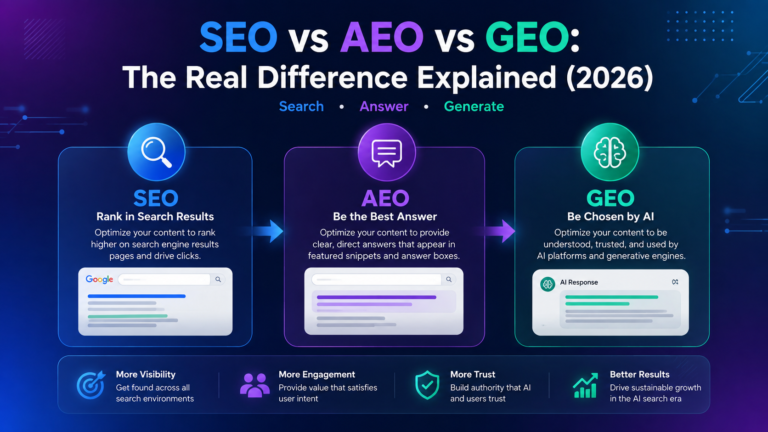
AI search optimization does not replace SEO. It builds on the same foundation and adds an additional layer focused on how systems synthesize and attribute information. Understanding where these disciplines overlap and where they diverge, along with related approaches like answer engine optimization, is covered in more depth in SEO vs AEO vs GEO.
Common Mistakes That Reduce AI Search Visibility
-
Publishing content that only rewrites what already exists elsewhere
-
Targeting a keyword phrase without understanding the actual question behind it
-
Creating isolated articles with no connection to a broader topic cluster
-
Using vague, hedge-filled explanations instead of direct statements
-
Making claims without support or overstating certainty
-
Leaving outdated statistics, screenshots, or instructions unchanged for years
-
Overusing unedited AI-generated filler that adds length without substance
-
Focusing entirely on formatting tricks while ignoring the quality of the underlying answer
-
Trying to manipulate citations directly instead of improving the information itself
A Practical AI Search Optimization Checklist
-
Confirm the page is crawlable, indexable, and loads without major technical barriers.
-
State a direct answer to the core question within the first few sentences.
-
Add original analysis, framework, or example that isn’t available on competing pages.
-
Make entity relationships explicit rather than implied.
-
Connect the page to a broader cluster of related content on the same site.
-
Include clear author or organizational information where relevant.
-
Verify statistics, examples, and instructions are current.
-
Use headings, tables, and lists to make key information easy to extract.
-
Add internal links to genuinely related resources.
-
Review and update the page on a regular schedule rather than leaving it static.
How to Measure AI Search Visibility
There is no single universal metric for AI search visibility, and any tool claiming to measure it definitively should be treated with some skepticism. Realistic ways to track progress include monitoring referral traffic from AI platforms where it is reported, tracking branded search growth as an indicator of awareness, watching for direct mentions of your brand or content in AI-generated answers when you can observe them, comparing impressions and query patterns in Search Console over time, and noting shifts in organic visibility that correlate with content or structural changes.
None of these measurements is exact, and attribution in AI search remains harder to track than traditional organic traffic. Treat them as directional signals rather than precise scorecards.
Conclusion
There is no single AI citation optimization trick, and any advice that promises one should raise questions. AI search optimization works the way strong publishing has always worked: create information that is genuinely original, answer questions clearly, build real context and authority around a topic, keep facts accurate and current, and make sure systems can technically access what you’ve built. Citations, mentions, and references follow from being a genuinely useful source, not from gaming a specific platform’s mechanics. The publishers who treat this as a discipline built on real value, rather than a shortcut, are the ones most likely to stay visible as these systems keep evolving.

Nikunj Pandya
Nikunj Pandya is an AI and technology professional with over 5 years of experience exploring how emerging technologies can solve real-world problems. He focuses on Artificial Intelligence, AI Search, and AI tools, sharing practical insights to help readers understand and make better use of new technology.